


The 80/20 gap of AI capabilities and realities is a real challenge to most. Every brand team has seen the same demo. Someone opens a laptop, types a prompt, and a remarkable image, video, or character appears in seconds. Wow, that is amazing. The room is impressed. A pilot project is greenlit, and a team starts to build a tool or platform to eventually implement as a service or capability. Eight weeks later, the work is not done, the brand standards review failed, the product looked wrong in 11 of 14 frames, and the team is quietly rebudgeting for a traditional production fix or a pivot. The pilot fails.
This is the 80% gap. The distance between the AI demo and the AI deliverable. It is the dominant failure mode in commercial AI creative right now, and it is not a tooling problem. The models are getting better every quarter. The gap remains.
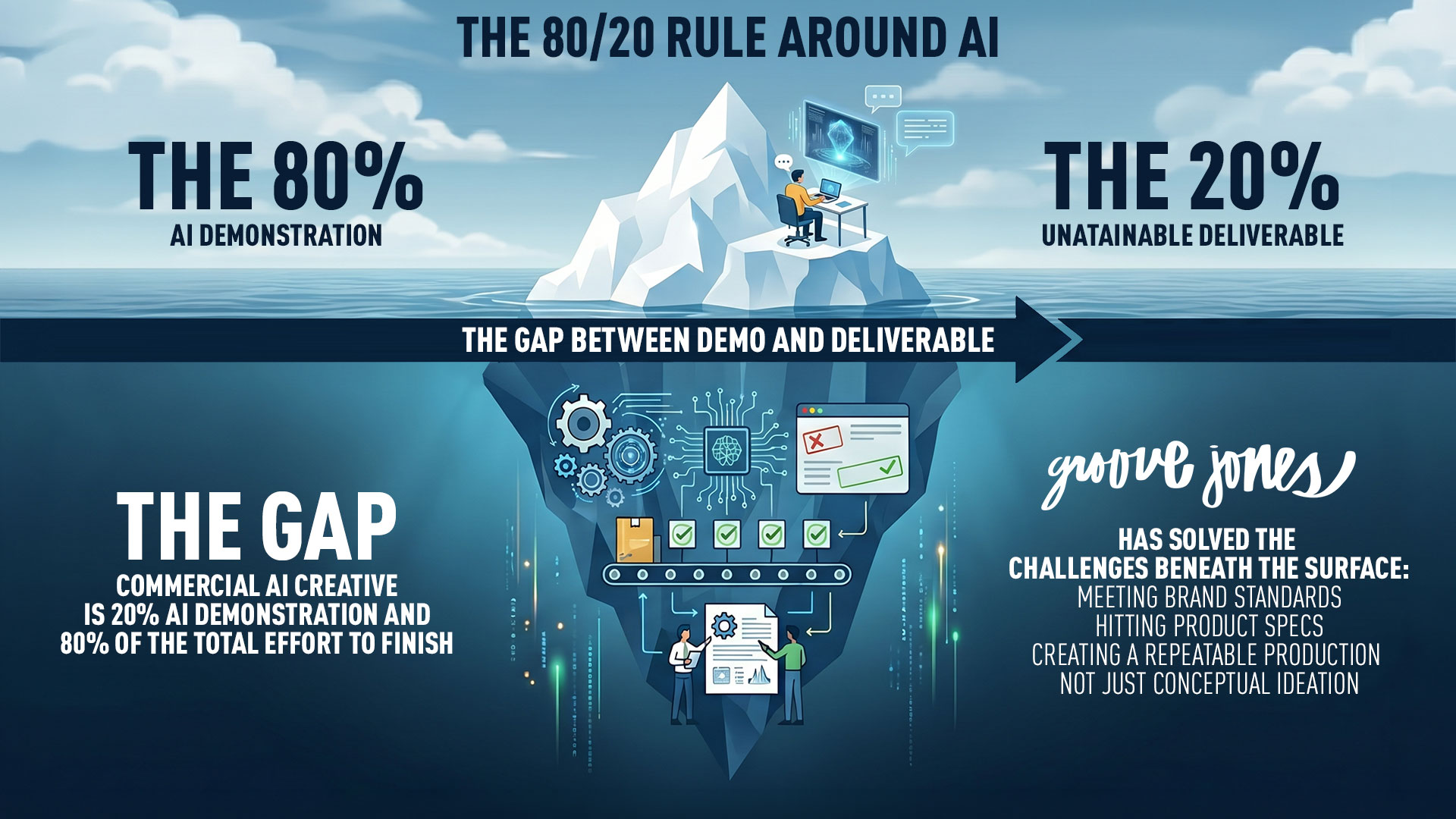
Most organizations are getting to the 80% mark of their AI-powered production, but rarely get to the 100%, professional production grade finish line, that is shippable and repeatable. They realize that the final 20% left is not really 20%, but could be an actual 80% effort to finish. It’s the 80/20 rule. 80% of what you think is the visible effort is just the 20% tip of an iceberg. They are only seeing the fast and easy part of the effort. What lies underneath the water is the real effort to create a repeatable production pipeline. That is where we have succeeded.
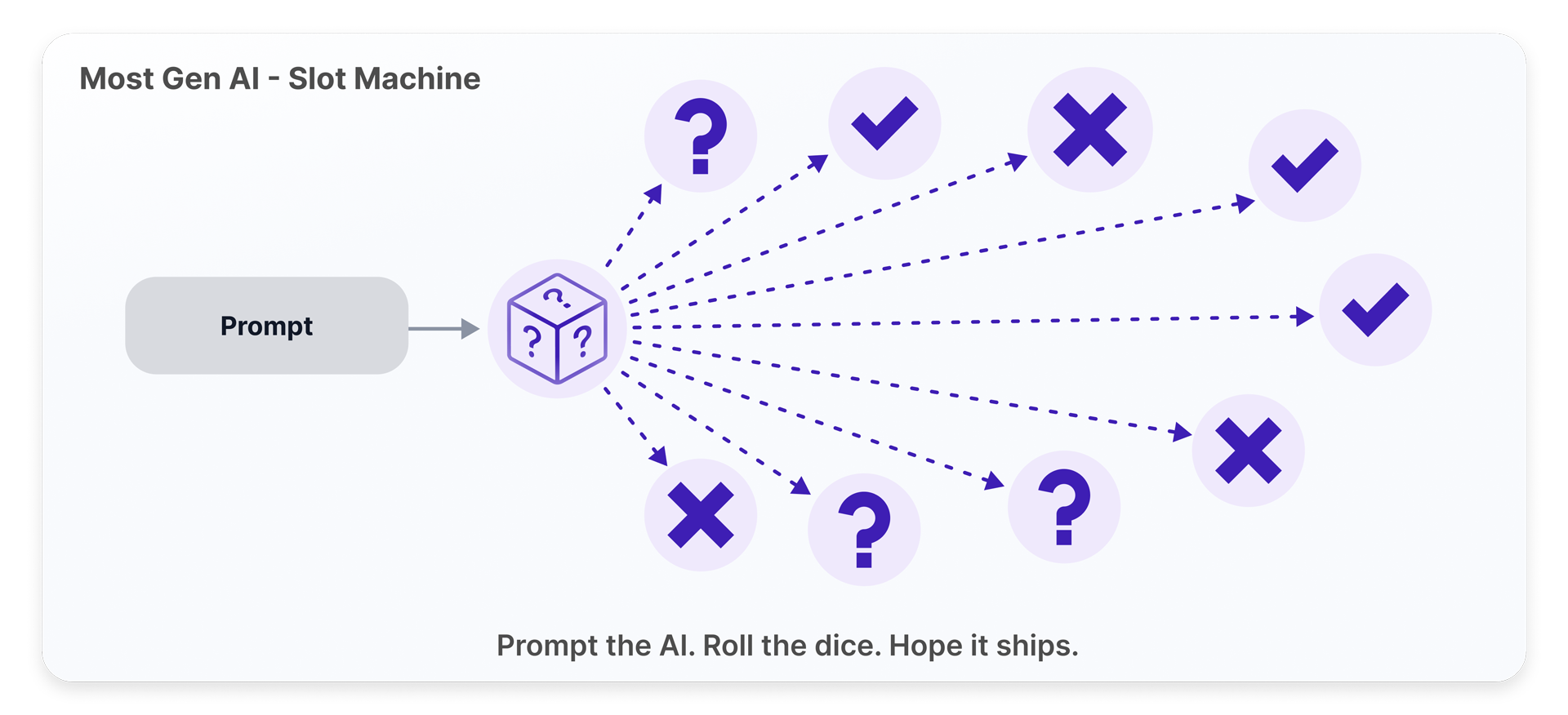
The gap exists because most of the industry is still treating generative AI as a slot machine. Prompt, generate, hope. Prompt again, generate again, hope harder. This approach works fine for personal exploration, social experiments, and conceptual ideation. It collapses the moment the work has to meet a brand standard, hit a product spec, clear legal review, and ship on a calendar.
The question is no longer whether AI can produce striking imagery. It can. The question is whether AI can produce the specific imagery a brand needs, at the fidelity a brand requires, on the timeline a campaign demands. That is a fundamentally different problem, and it requires a fundamentally different approach. We call that approach Directed AI, and we excel at it. It is also the work that the world’s most demanding brands trust us to deliver: Adobe, Alcon, AT&T, Bandai Namco, Crocs, DICK’S Sporting Goods, HSBC, Invesco QQQ, Keebler, LG, the NFL, Oracle, PepsiCo, Salesforce, SC Johnson, ServiceNow, Southwest Airlines, and State Farm.
The Slot Machine Problem
Generative AI, used naively, is non-deterministic by design. The same prompt produces different outputs. The same workflow yields different results from one session to the next. For an artist exploring possibilities, this is a feature. For a production team delivering a branded campaign, it is the central operational problem.
Brand work has constraints that personal creative work does not. A Croc shoe has a precise silhouette. A logo has exact proportions. A product color must match the swatch. A character must remain consistent across thirty shots. A campaign must land on a specific date, at a specific spec, in a specific channel, with specific legal clearances. None of these constraints are negotiable. All of them are hostile to randomness. The slot machine fails three tests in particular:
- The fidelity test – Can the system reliably render the actual product, not a plausible interpretation of it? Naive generative workflows almost always drift. The Croc becomes a generic clog. The logo becomes a smudge. The proportions soften. For brand work, “close enough” is not close enough.
- The consistency test – Can the system produce a sequence of frames, or a series of shots, that hold together? Most generative video models still struggle here. Hair changes between cuts. Clothing morphs mid-motion. Backgrounds shift. The slot machine produces beautiful individual outputs and incoherent ones in aggregate.
- The accountability test – When something goes wrong, can the team explain why and fix it? Pure prompt-based workflows are essentially black boxes. When a frame breaks, the only intervention is to re-roll the dice. For a studio responsible to a brand client, that is not a defensible position.
Studios that ignore these tests can produce impressive single images. They cannot ship campaigns or interactive experiences. The work either does not get made, it gets made and quietly fails review, or launches with risk, and you pray it doesn’t cause you to lose your job.
The Directed AI Solution
There is a different model. We have been refining it for several years, across hundreds of productions, and it is the foundation of the work that recently won the 2026 AARON Award for Best AI Workflow for Production. The principle is simple to state and demanding to execute:
AI is a medium, not an author. A pipeline, not a prompt. Direction, not generation.
Directed AI treats generative tools the way visual effects artists have always treated their tools: as instruments within a controlled production workflow, not as creative agents that replace artistic judgment. The job of the studio is to direct the system, frame by frame, decision by decision, toward an outcome that meets the brief. The AI accelerates that direction. It does not replace it.
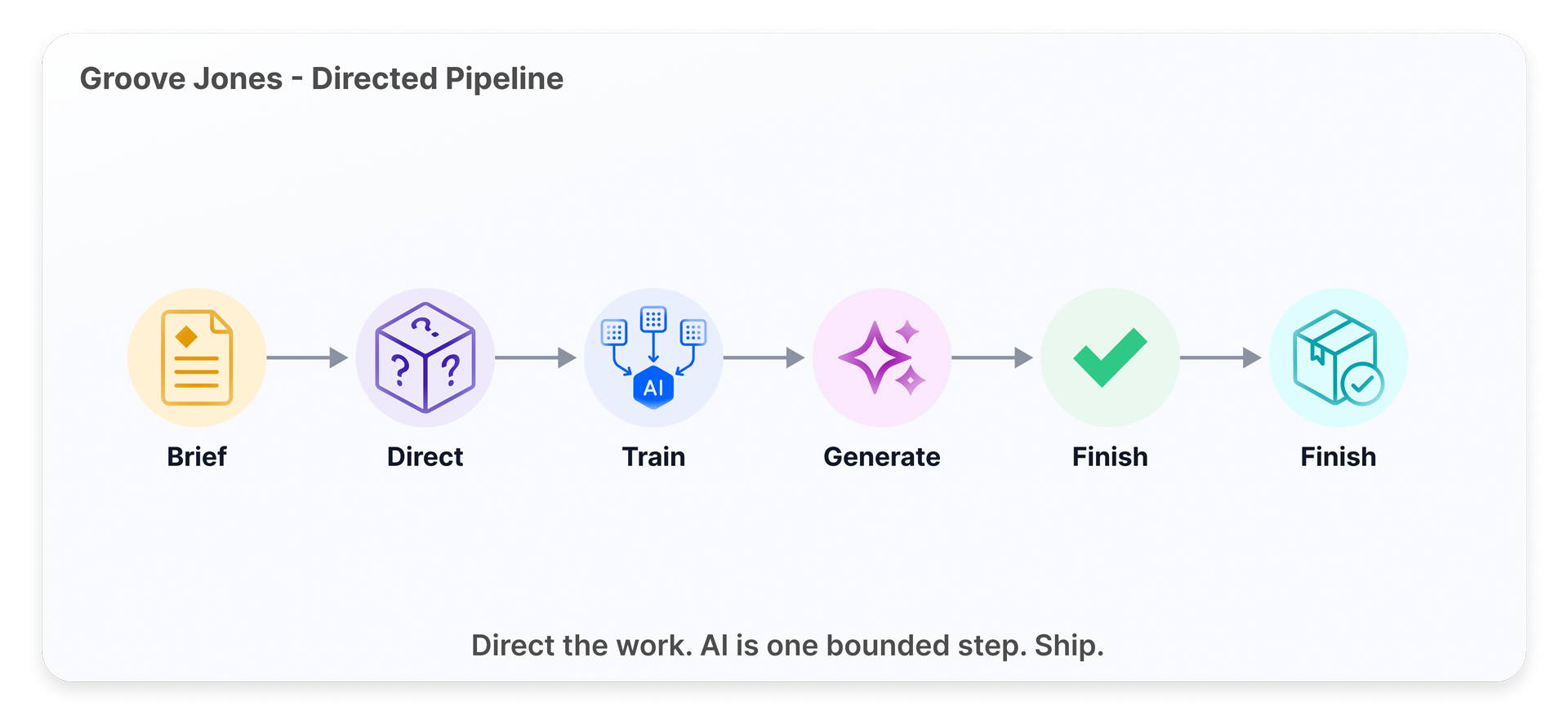
This is not a rejection of AI. It is a refusal to abandon craft. The directed approach rests on five operating principles.
- Composition before generation – Every shot begins in traditional 3D. Camera angles, motion paths, product placement, and timing are blocked and locked before any generative tool is opened. This eliminates the slot machine problem at the source. By the time AI enters the workflow, the composition is already decided. The system is filling in a known frame, not inventing one from scratch.
- Custom-trained models for brand fidelity – Off-the-shelf models do not know your product. They know an average of a million products that look vaguely like yours. For commercial work, this is not acceptable. Custom LoRA training on actual product imagery preserves the specific silhouette, material, color, and detail that brand standards require. The model is taught the brand before it is asked to generate.
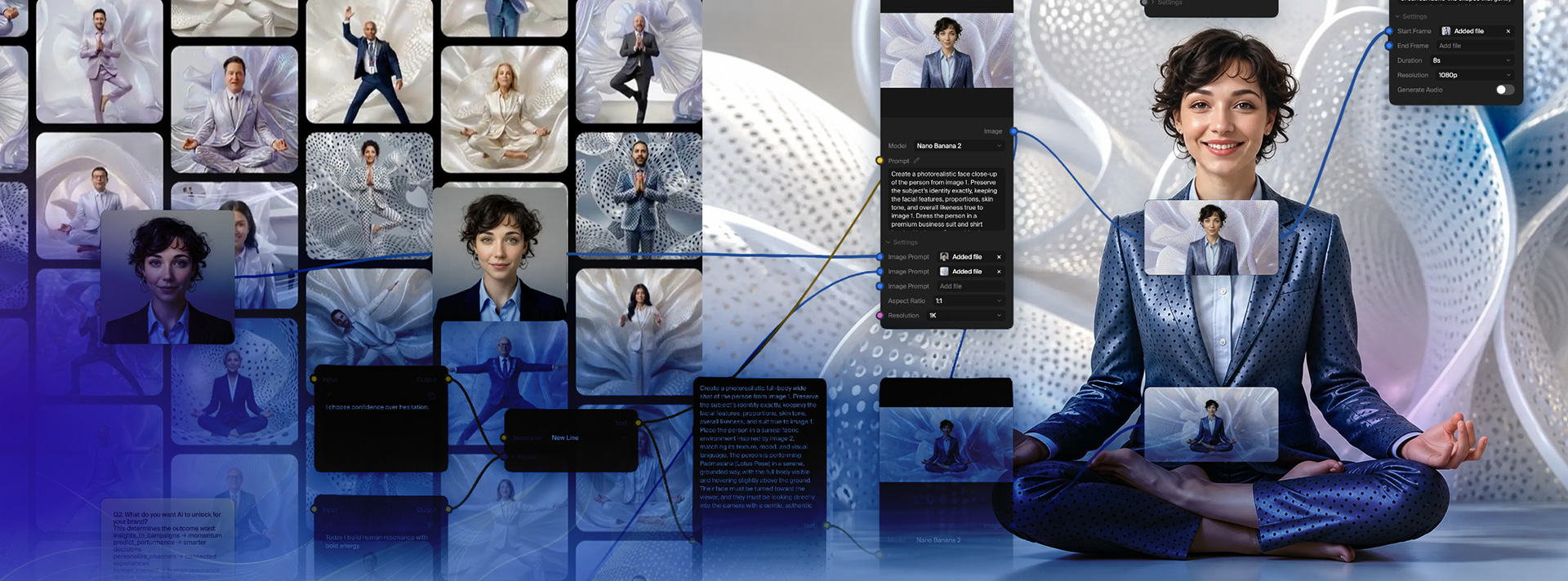
- Anchor frames, not autonomous sequences – Rather than asking an AI video model to invent motion from a prompt, the directed workflow generates highly curated start and end frames, then constrains the model to interpolate between them. This converts a non-deterministic problem (generate a video) into a bounded one (animate between these two locked images). The system has fewer degrees of freedom, and the output is dramatically more controllable.
- Traditional VFX as the finishing layer – Generative output is the middle of the process, not the end. Every frame moves into compositing, paint, edge refinement, temporal cleanup, and corrective machine-learning passes inside professional tools like Nuke. This is where the work becomes brand-ready. The discipline of compositing is what separates a striking AI image from a deliverable campaign asset.
- Human judgment at every handoff – The pipeline is full of decision points where artists select, reject, refine, and redirect. The AI generates. The human chooses. The AI assists. The human authors. This is not a slogan; it is a workflow constraint. No frame ships without explicit human approval at multiple stages, and every stage produces artifacts (storyboards, LoRA training sets, anchor frames, comp scripts) that can be reviewed, audited, and revised.
Together, these principles do something the slot machine cannot: they make AI dependable. Not faster than artistry, but faster than artistry was without it. Not a replacement for craft, but a force multiplier for it.
Three Applications, One Discipline
Directed AI is not a single workflow. It is a philosophy that applies across three distinct categories of creative work, all of which sit downstream of the slot machine problem and require the same operational discipline to solve.
The first application is generative content production. Making AI produce imagery, motion, characters, and environments that meet brand standards and ship at production quality. This is the category most readers will associate with the term “AI creative.” It is the category the principles above were written to describe.
The second application is AI-accelerated traditional production. Using AI to compress the build cycle of traditional creative work so radically that design ambition can survive contact with engineering reality. The output is not generated by AI. The work is accelerated, sharpened, and made more iterative by AI being directed inside the production process. Visualization tools, interactive experiences, and complex creative builds that would have taken months to design, prototype, and refine can now be done in days.
The third application is real-time interactive AI. Deploying AI live and in the moment, in front of an audience, where computer vision, voice synthesis, and conversational characters have to perform on demand without a single misfire. The output is generated in real time, but it is never left to chance. Every model is parameterized, bound to a brand-safe script, and anchored to a robust architecture so the experience stays on brand and on its feet under the pressure of a high-traffic event or a globally recognized character.
The applications produce different outputs. They use different tools. They live in different parts of the studio. They share one thing: AI is a bounded, directed step inside a workflow that humans control on both ends. The same philosophy. The same discipline. The same accountability.
The case studies that follow demonstrate each application in turn.
Proof, Part One: Award-Winning Social Video Production for Crocs x NFL Campaign
When DICK’S Sporting Goods and Crocs needed to launch the Crocs x NFL collection during football season, the brief called for a hyper-realistic spectacle. Giant NFL-licensed Crocs parachuting into DICK’S parking lots, captured in a cinematic, faux out-of-home style, designed for vertical social.
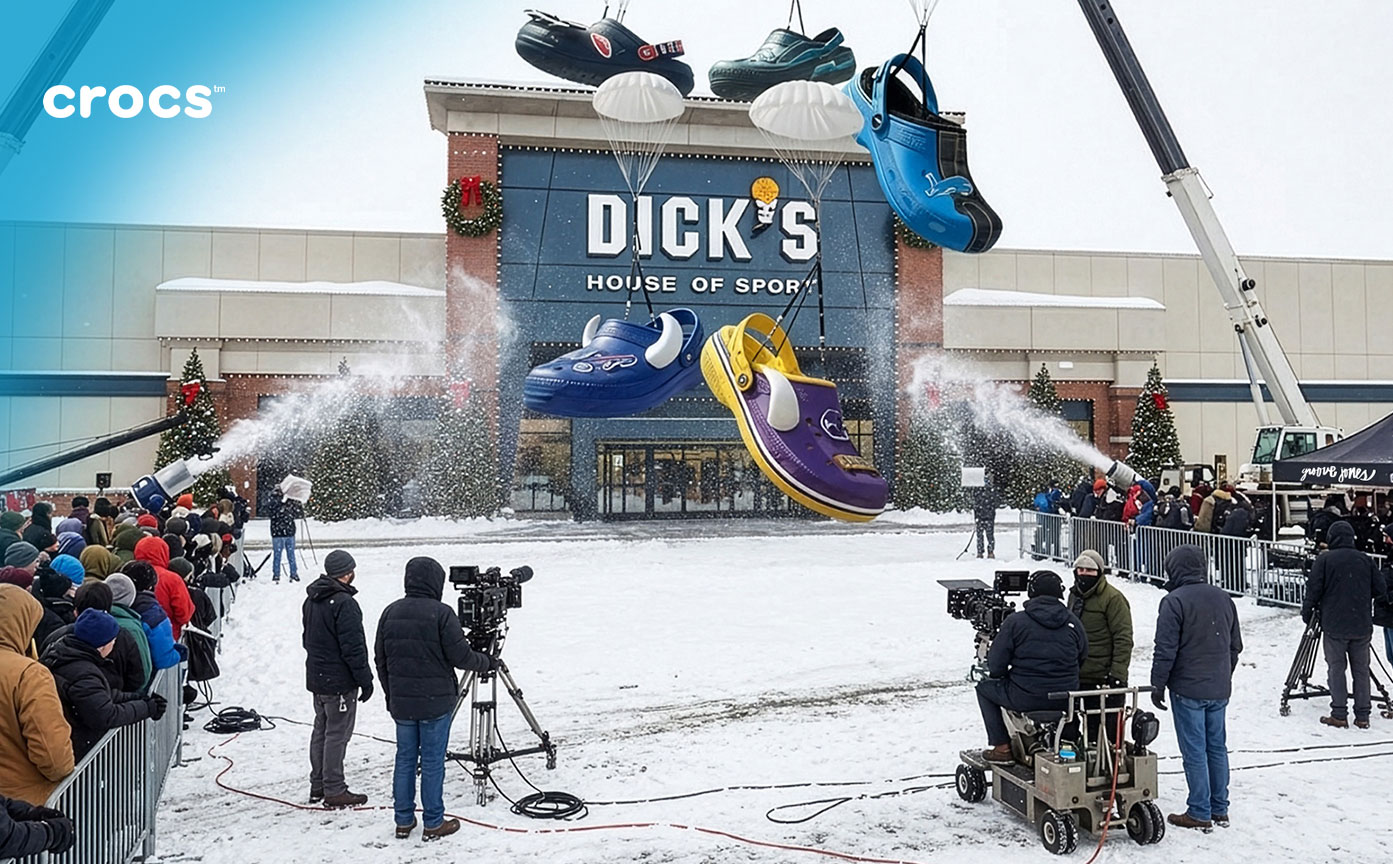
The slot-machine approach would have failed this brief. The Crocs would have looked plausible rather than accurate. The Jibbits would have drifted between frames. The team-licensed clogs’ brand color would have wavered. Fast motion would have introduced artifacts. The campaign would have been a beautiful approximation of the product, which is to say a legal liability and a brand violation. An important note: this production was the NFL’s, Dick’s Sporting Goods’, and Croc’s first time using AI-created media in an advertising or social campaign, so everything needed to be on brand and accurate.
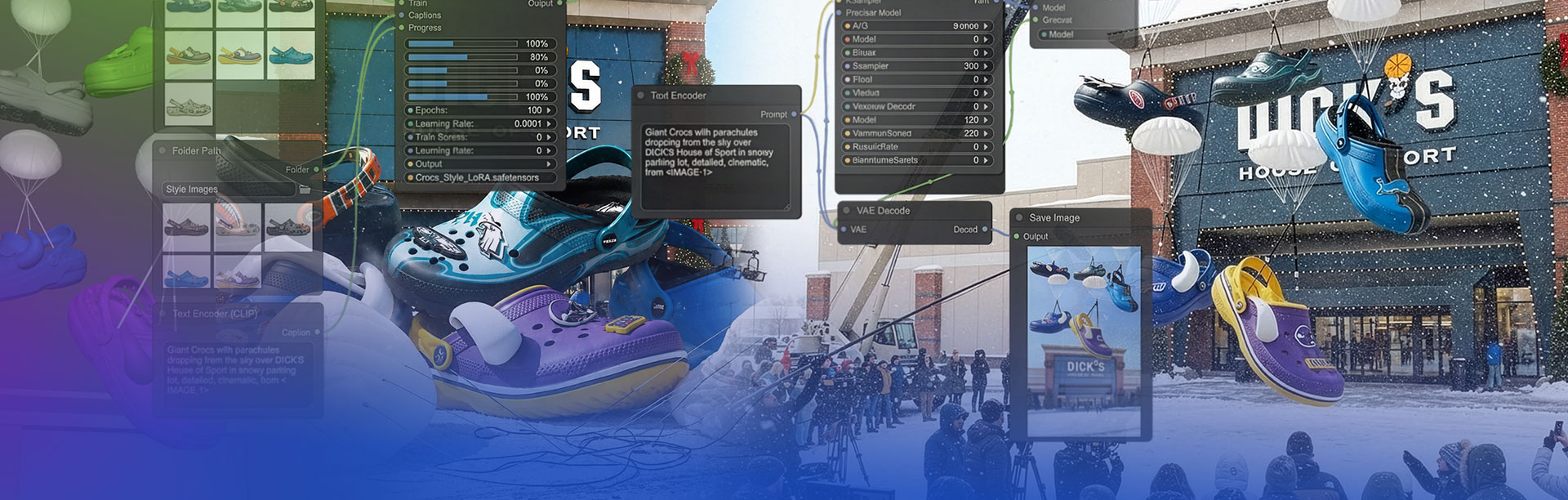
The directed approach delivered the work. The team began in traditional 3D, blocking camera moves and product staging before any generative tool entered the workflow. Custom LoRAs were trained on actual Crocs NFL Team Clog imagery, then used to produce art-directed anchor frames. Generative video tools created motion between those anchor points, constrained by the brand-trained models. Every output landed in Nuke for compositing, where machine-learning passes were trained to maintain Jibbit accuracy and material consistency across dynamic action. Falling snow, camera shake, and crowd energy were composited in. Sound design and editorial pacing finished the piece.
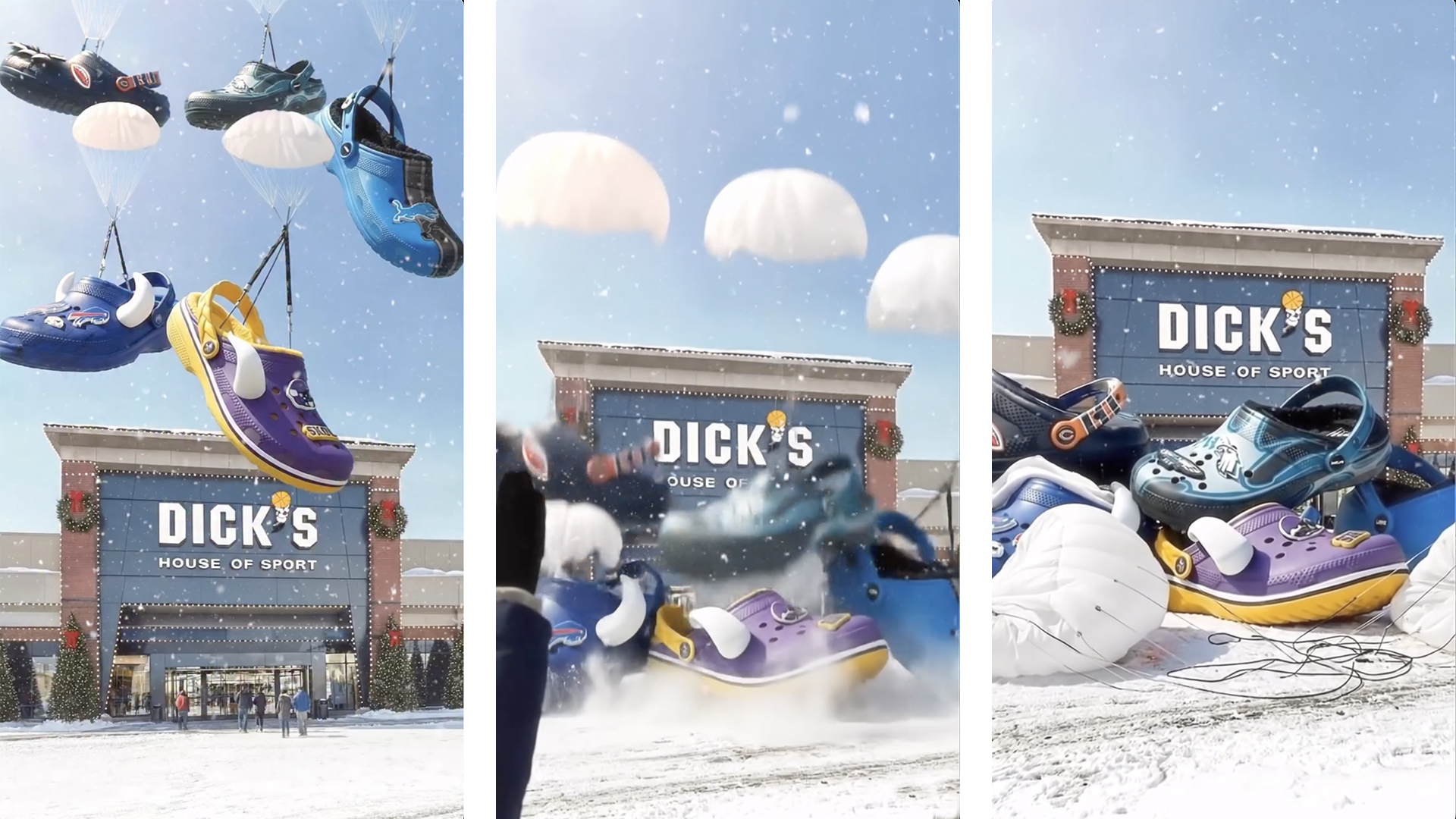
The campaign generated 751,000 views, 7,463 likes, 378 shares, and 111 comments on Instagram. Notably, 5% of users who liked the post also shared it; the typical share-to-like ratio for branded social content is well below 1%. The work landed in culture, drove engagement, and protected the brand at every frame.
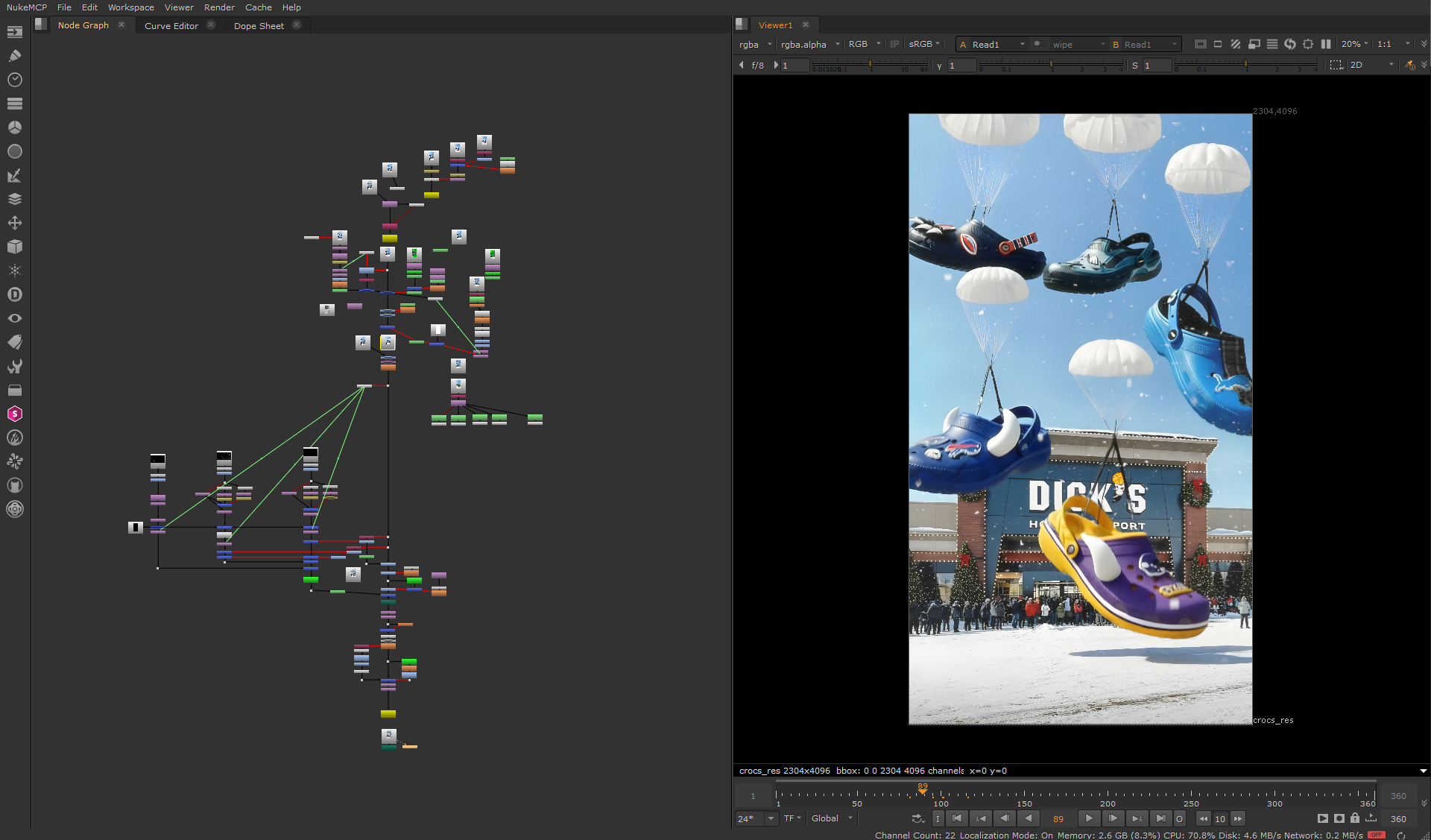
In April 2026, the campaign won Best AI Workflow for Production at the AARON Awards. The jury noted that the category recognizes “the systems behind the work, including the thinking, structure, and execution required to bring AI to a true production level.” That is not a recognition of a creative output. It is a recognition of a discipline. Learn more about the work here – https://www.groovejones.com/dicks-sporting-goods-fooh-holiday-campaign-crocs-nfl-collection
Proof, Part Two: Africa Finance Corporation Rapid Web App Development
Africa Finance Corporation needed something different. Complex, multidimensional, geo-tagged logistics data covering the continent had to become an interactive, experiential visualization that decision-makers could actually use. The challenge was not whether AI could generate the visualization. It could not, and that was never the brief. The challenge was operational. Months of typical design-and-engineering iteration had to be compressed into a timeline that would let the design intent remain ambitious rather than be value-engineered out during the build cycle.
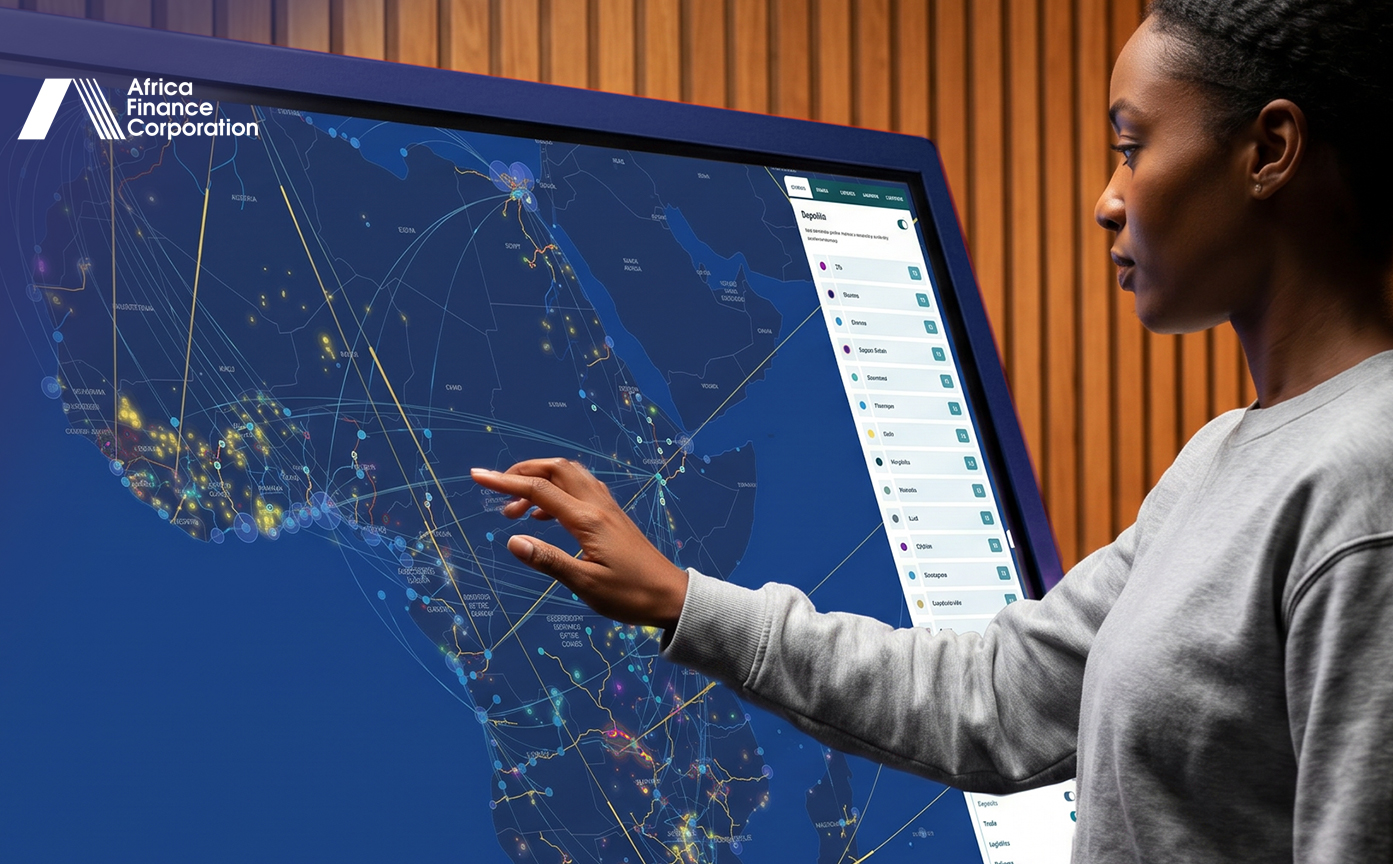
The conventional approach would have proceeded in serial. Designers would specify the visualization. Engineers would build a prototype over the course of weeks. Designers would review and request changes. Engineers would re-build. Repeat. Every iteration cycle would lose detail to translation. Every design ambition would be tested against the pressure of schedule. The work would ship, but the version that shipped would be five steps removed from the originally designed version.
The directed approach changed the build cycle. Agentic AI coding tools were brought inside the workflow as a compression layer between design and engineering. Designers worked against functional prototypes in hours rather than weeks. Engineers stepped in to direct the AI tooling, validate output, harden the code, optimize performance, and finish the work to production standards. The AI did not design or engineer the visualization. The AI removed the bottleneck between the two disciplines.
The discipline was identical to the Crocs production. Humans directed the intent: data architecture, visual hierarchy, interaction design, narrative structure. AI accelerated a bounded step: translating design specifications into working code. Humans finished the work: refinement, performance, data validation, production hardening. The AI was not the designer. It was not the engineer. It was the compression layer between them.
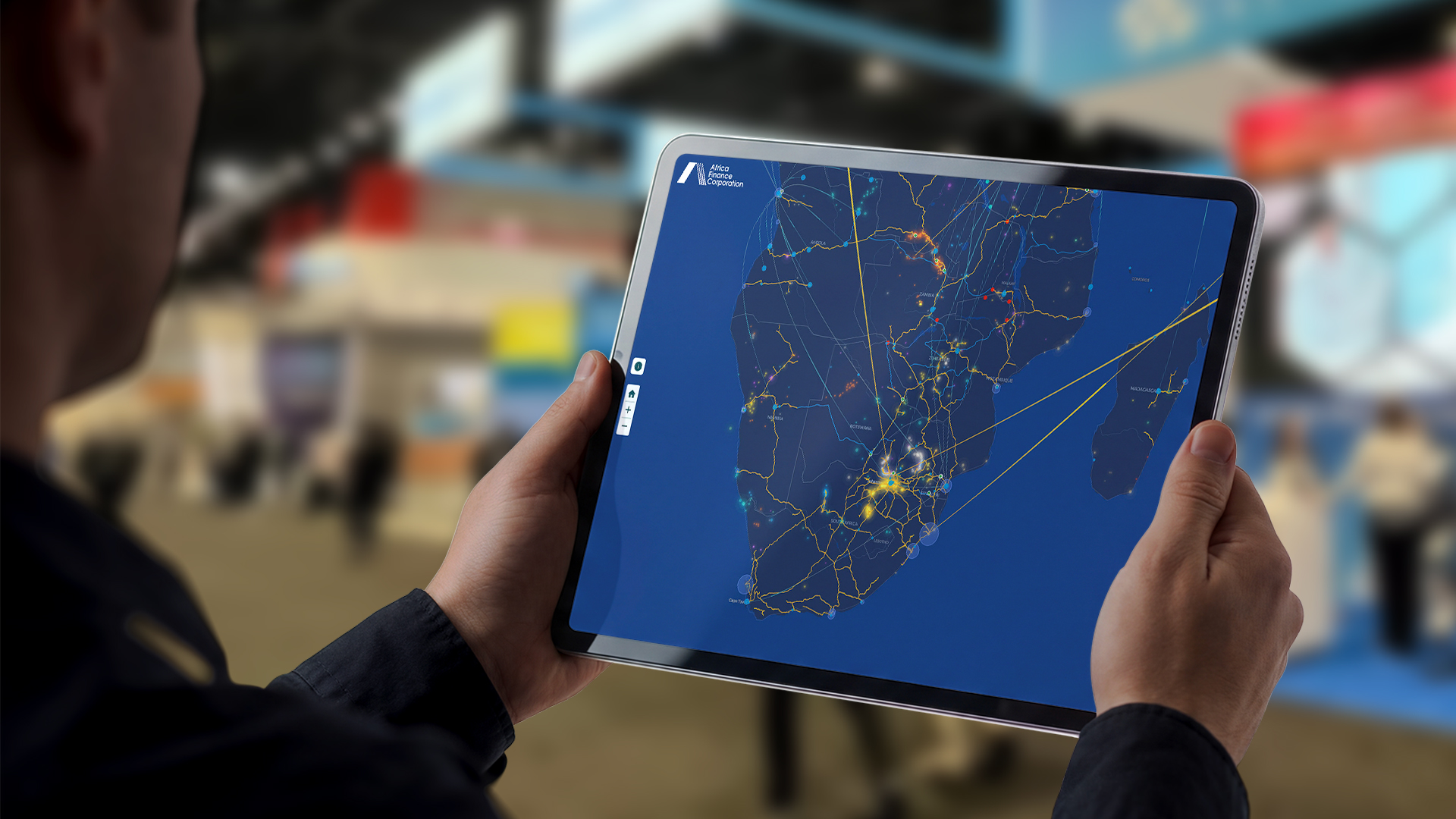
The outcome was a visualization tool that retained the full ambition of the original design because the build cycle never forced compromises. AFC received a working product on a timeline that traditional workflows could not have matched, at a level of polish that the slot-machine alternative could not have approached. Learn more about the work here: https://www.groovejones.com/interactive-logistics-mineral-deposits-data-map-africa-finance-corporation
The lesson generalizes beyond data visualization. Any creative build that has historically been slowed by the gap between design and implementation is a candidate for this application of directed AI. Interactive installations. Custom web experiences. Bespoke training and enablement platforms. Anywhere creative ambition is currently being trimmed to fit engineering capacity, the directed AI approach restores ambition to the design without requiring the engineering team to grow.
Proof, Part Three: Event Social Share Media Engagement for Alcon Surgical Magic Mirror Event
To demonstrate how Directed AI can elevate live events without sacrificing reliability, Groove Jones developed a custom interactive video activation for Alcon’s inaugural New Technology Showcase. Utilizing our FitCheck™ Magic Mirror platform, the team designed a custom 1920s Art Deco period-costume experience that matched the historic aesthetic of Fort Worth’s T&P Station. Rather than relying on unpredictable, unconstrained generative outputs that can fail under pressure, the experience used advanced computer vision and real-time markerless body tracking to instantly replace what guests were wearing with highly stylized, beautifully rendered digital wardrobes. The clothing tracked poses and physical gestures seamlessly in real time, whether single or multiple guests stepped up to the 4K display.
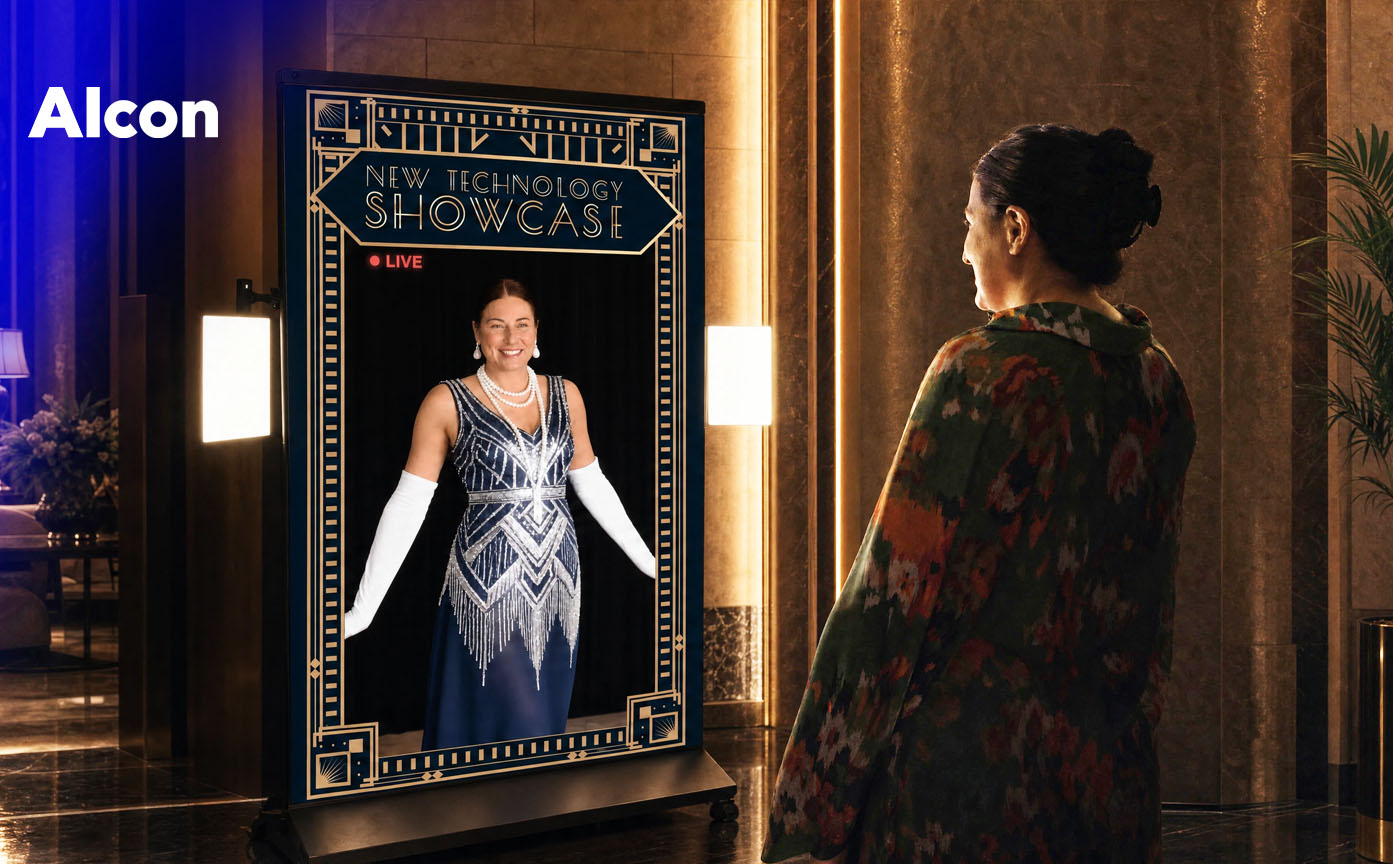
Built to handle the intense, rapid flow of a high-traffic professional event, the battle-tested pipeline dynamically captured individual guest interactions, composited the footage into custom-branded animated video shorts with music, and served them up via instant QR codes.
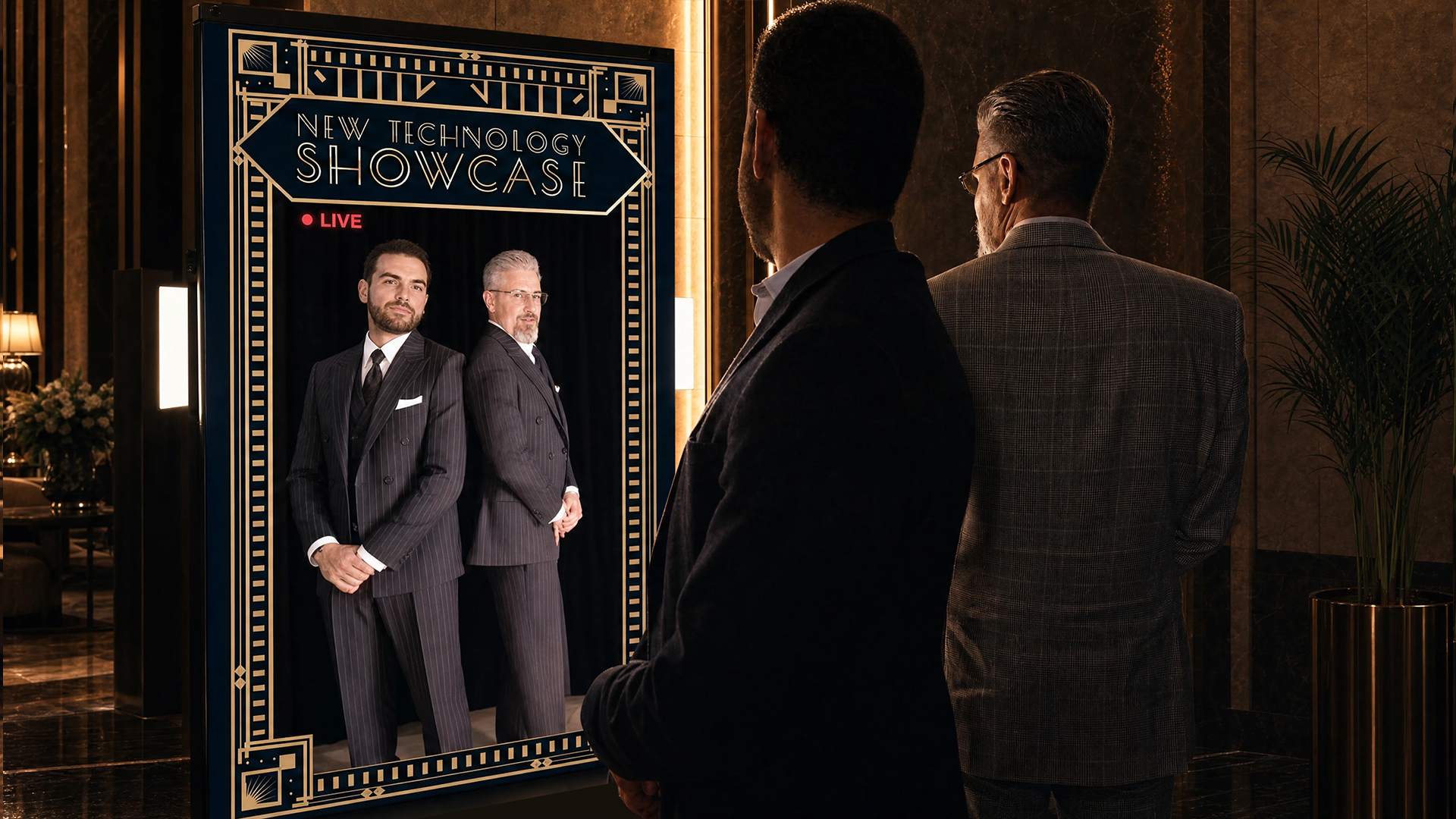
The result was a flawless, low-friction activation that generated personalized, high-quality social-share videos for every participant, extending the event’s reach across social platforms while keeping creative and technical results perfectly aligned with Alcon’s brand standards. Learn more about the work here – https://www.groovejones.com/alcon-magic-mirror
Proof, Part Four: Award-Winning Voice Synth and Dynamic Game for Invesco QQQ AI NCAA Final Four Experience
When an activation demands massive throughput on sports’ biggest stages, a production-ready AI pipeline is non-negotiable. For the NCAA Final Four Men’s and Women’s Championships, Groove Jones partnered with 160Over90 to create the Invesco QQQ Innovation Arena—an immersive phygital fan experience that seamlessly blended a physical half-court with a 15-foot-tall LED volumetric stage. To fully immerse thousands of fans in a pressure-packed “Buzzer Beater” moment, we integrated a multi-layered, highly directed AI system. An advanced monocular computer vision algorithm tracked player and ball positions from a top-down view to control an intelligent CGI crowd that reacted dynamically to the play-by-play performance.
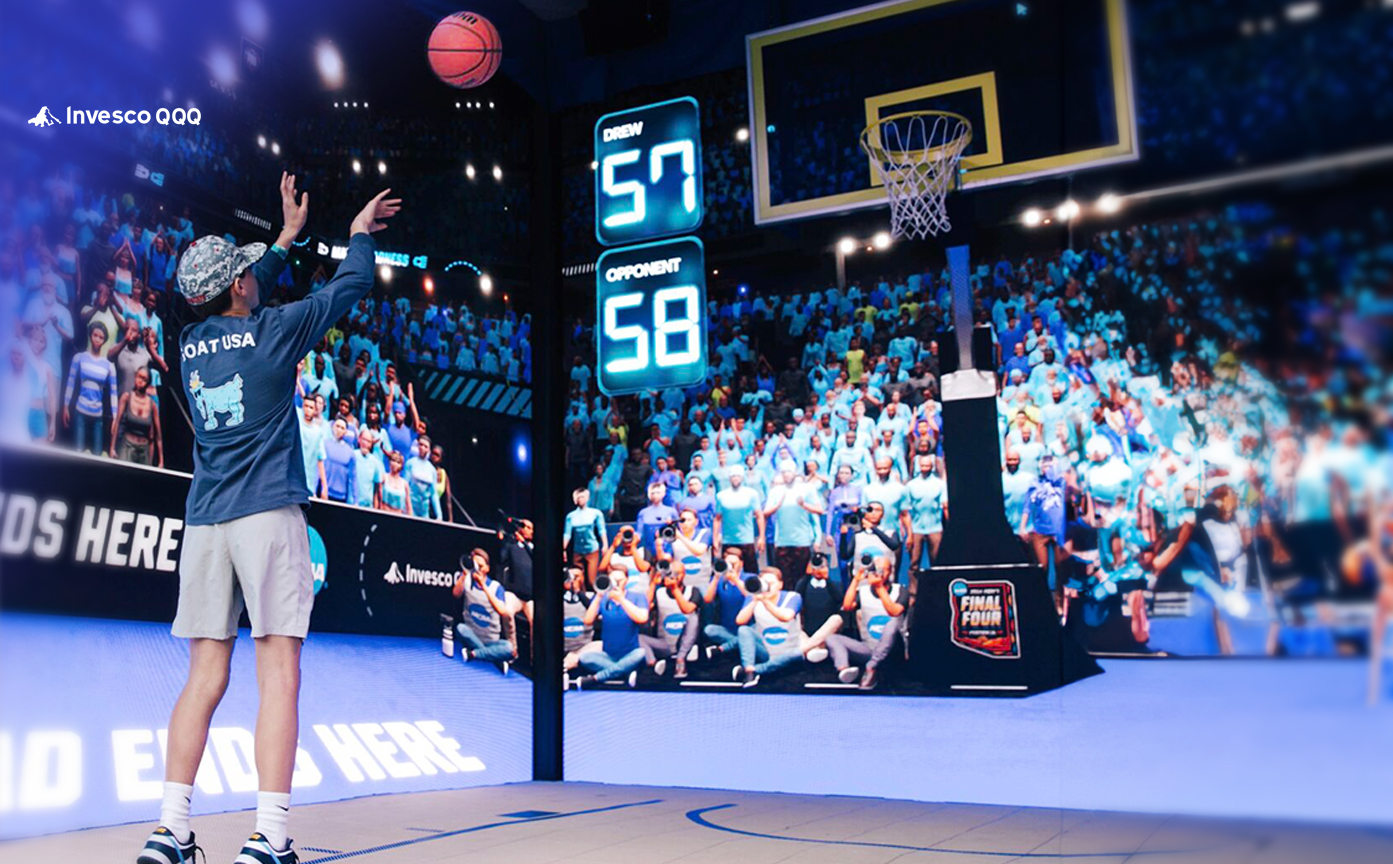
Crucially, the experience relied on strict AI parameterization for voice and personalization. Upon registration, a directed text-to-speech AI system, trained on a professional announcer’s voice talent, called out the player’s actual name in real time, delivering customized commentary and performance-based nicknames over a roaring 5.1 sound system.

Later iterations even integrated computer vision to act as an automated coach, delivering instant shot heatmaps, trajectory analysis, and scoring breakdowns. By binding generative voice synthesis and vision analytics to a predictable, robust local architecture, the experience delivered automated, highly personalized content for thousands of fans in high-traffic environments without a single system hiccup. Learn more about the work – https://www.groovejones.com/invesco-qqq-ai-ncaa-final-four-experience
Proof, Part Five: Award-Winning Voice Synth and Avatar Chat Experience for Scooby-Doo Character Studio
When deploying generative AI for world-class, globally recognized intellectual property, maintaining strict character integrity is the ultimate test of a Directed AI workflow. For Warner Bros. Discovery and Acme Innovation’s Scooby-Doo Character Studio, Groove Jones engineered an interactive, customized e-commerce experience that safely brought a beloved icon to life through real-time AI voice chat. Instead of leaving the character’s voice to an unpredictable, unconstrained large language model, the system used a heavily parameterized conversational layer.

The team integrated advanced AI voice synthesis specifically trained to mimic Scooby-Doo’s signature speech patterns, vocabulary, and unique impediments (like his famous “R” sound insertions) while keeping his responses securely bound to a family-friendly, on-brand script.

The activation allowed fans to step into the Mystery Inc. gang themselves, using an AI-assisted customization engine to design their own stylized avatars alongside Scooby and friends. By anchoring generative voice synthesis and dynamic character interaction within a highly robust, predictable digital pipeline, the studio delivered a frictionless, deeply engaging consumer experience that translated nostalgic emotional connection directly into customized e-commerce collectibles. It stands as a prime example of how Directed AI can harness the magic of real-time voice generation while enforcing the absolute guardrails required by legendary entertainment brands. Learn more about the work: https://www.groovejones.com/scooby-doo-character-studio-an-interactive-customized-collectible-e-commerce-experience
Industry Recognition
The industry-wide validation for this controlled, scalable approach culminated at the 2026 AARON Awards, where Groove Jones won “Best AI Workflow for Production” for our DICK’S Sporting Goods and Crocs NFL Collection Holiday Campaign. We have also won awards for “Best Use of AI & Machine Learning” at the VEGA Awards for our work for ServiceNow, and “Best AI Creative Innovation” at the Davey Awards for our Open for Magic Selfie Studio for Keebler Company and Ferrero SPA.

The AARON Awards establish the global benchmark for creative artificial intelligence, and this specific category recognizes the robust systems, structured thinking, and repeatable execution required to bring AI out of the playground and into a true enterprise production environment. By blending generative AI pipelines with traditional cinematic VFX to create a massive Faux Out-of-Home (FOOH) campaign, the jury honored Groove Jones for establishing a scalable workflow that prioritizes speed, absolute control, and extreme visual fidelity—proving that success with AI isn’t just about the creative output, but the dependable pipelines that make it happen.
Why This Matters Now
The conversation in brand and agency leadership has shifted in the last twelve months. The question used to be “can we use AI?” The question now is “who can we trust to use AI on our work?” Those are very different questions, and they require very different partners. Brands that lean on slot-machine AI will continue to produce striking demos and inconsistent campaigns. They will get good press for the first hit and quiet conversations for the second and third. Their procurement teams will eventually catch up to the pattern and the work will move elsewhere.
Brands that adopt a directed AI approach (whether they build it internally, partner with studios that have built it, or both) will produce work that meets the standards that mattered before AI, and that still matter now. Their campaigns will ship. Their products will look right. Their lawyers will sleep. Their creative directors will recognize the work as their own. Their visualization tools will arrive in weeks instead of quarters. Their interactive experiences will retain the ambition with which they were designed.
The next generation of leading creative work will not be made by the studios with the best access to models. The models are commoditizing. It will be made by the studios with the best workflows around the models. That is a different competitive frontier, and it favors discipline over novelty.
Why Our Capabilities Matter More Than the Tools – Industry Option About Our Approach
Every studio can access the same frontier AI models. That access is table stakes now. What separates good work from great work is everything built around the technology: the production methodology, the creative decisions, and the workflow that holds quality together across a complex execution.
That’s what we build. Our capabilities aren’t a single platform; they’re the accumulated craft, pipelines, and people that turn commoditized tools into work that stands apart. It’s the reason our Crocs x NFL FOOH campaign for DICK’S Sporting Goods won the 2026 Aaron Award for Best AI Workflow for Production, and why Mumbrella cited it as evidence that the real advantage in AI production lives in the workflow, not the platform. Read the article here – https://www.groovejones.com/agencies-say-their-ai-is-the-difference
What This Changes for Buyers
For brand, agency, and enterprise teams evaluating AI partners, directed AI changes the buying criteria in five ways. The right diligence questions are no longer “what tools do you use” or “can you show me an AI reel.” They are operational. Show me your workflow. Show me how you maintain product accuracy. Show me what happens when a frame breaks. Show me your custom training process. Show me where humans make decisions. Show me how you compress build cycles without compromising quality. Show me work that shipped, at scale, on deadline.
The right pricing model is no longer per-asset, per-prompt, or per-render. Directed AI is closer in shape to a traditional VFX or systems-integration engagement than to a generative experiment. Studios that price it as the latter are selling the slot machine.
The right success measure is no longer “we used AI on this.” That is no longer interesting in 2026. The measure is whether the work performed aligns with the brief, channel, brand, and timeline. The Crocs campaign is notable because of what its share-to-like ratio reveals about audience response. The AFC visualization is notable for what the compressed timeline preserved of the original design. Neither is notable for the involvement of AI.
The right risk frame is no longer technological. It is operational. The risk in AI work today is not that the model will fail; it is that the workflow around the model will fail. Diligence belongs on the workflow. The right partner is no longer the team with the most impressive recent demo. It is the team that can answer all of the above with evidence, not slides. The Groove Jones portfolio of shipped, successful productions is monumental and a testament to the studio’s innovation and capabilities.
The Standard
The film industry underwent this transition in the 1990s, when CG entered visual effects. The shops that won were not the ones with the best raw rendering technology. They were the ones who built the production pipelines, the review processes, the artist training, and the QC discipline that turned a new technology into a dependable creative medium. The CG transition rewarded operational seriousness more than tooling fluency.
The same is true now. The studios that will define the next decade of creative work are the ones building the workflows, frameworks, and disciplines that turn generative AI from a slot machine into a medium and agentic AI from a coding novelty into a creative compression layer. The directed AI approach is our submission for what that discipline looks like across both applications. It is not the only valid answer. It is the answer that has produced the work, won the recognition, and earned the trust of the brands, agencies, and enterprises we partner with.
The slot machine will continue to produce demos. The pipeline will continue to ship campaigns and build the experiences and tools the next decade of work depends on. The industry will sort itself accordingly.


