



Dallas, TX – January 20, 2026 – Groove Jones Co-Founder and Partner Dan Ferguson recently shared insights on the evolution of XR, emerging technology, and immersive storytelling in an in-depth interview with Bruno Cuesta, editor and producer at TIA (Top Interactive Agencies). The conversation explored how purpose, creativity, and human-centered design continue to shape the studio’s work and the broader immersive landscape.
With more than three decades of experience across digital media, interactive design, and experiential innovation, Dan has helped guide Groove Jones into one of the most awarded XR studios in the world. Founded in 2015, the Dallas-based studio has earned over 300 industry honors while delivering immersive solutions across AR, VR, MR, AI, and experiential design for global brands in entertainment, marketing, healthcare, and training.
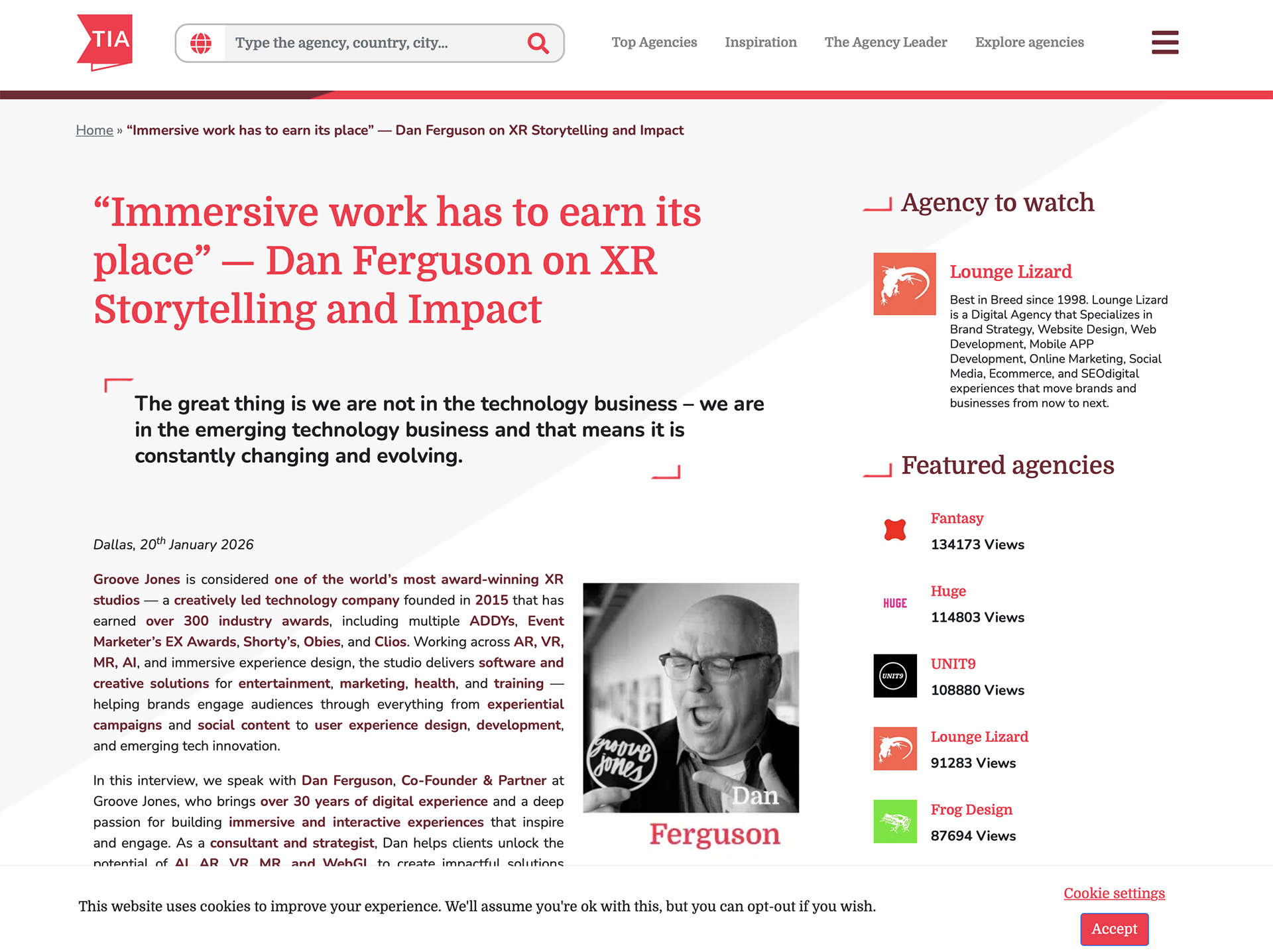
Groove Jones is considered one of the world’s most award-winning XR studios — a creatively led technology company founded in 2015 that has earned over 300 industry awards, including multiple ADDYs, Event Marketer’s EX Awards, Shorty’s, Obies, and Clios. Working across AR, VR, MR, AI, and immersive experience design, the studio delivers software and creative solutions for entertainment, marketing, health, and training — helping brands engage audiences through everything from experiential campaigns and social content to user experience design, development, and emerging tech innovation.
In this interview, we speak with Dan Ferguson, Co-Founder & Partner at Groove Jones, who brings over 30 years of digital experience and a deep passion for building immersive and interactive experiences that inspire and engage. As a consultant and strategist, Dan helps clients unlock the potential of AI, AR, VR, MR, and WebGL to create impactful solutions across experiential marketing, training, and entertainment, while also leading the development of the studio’s own B2B and B2C software products. His work has earned recognition across the industry, and he also serves as a judge for the Academy of Interactive & Visual Arts.
Dan, it’s great to speak with you. You’re based in Dallas, a city where creativity and technology intersect in interesting ways. How has being in Dallas influenced your perspective on innovation and immersive storytelling?
Dallas has shaped the way I think about innovation because the city has this rare mix of entrepreneurial energy and practical problem solving. They call it the “Silicon Prairie,” because of the tech companies here like Texas Instruments, AT&T, and Microsoft. Plus there are a lot of game companies here. You feel the influence of major industries, from sports to retail to tech, all pushing for new ways to break out and disrupt things. Working here makes you stay grounded while still dreaming big.
If someone were visiting Dallas for the first time and wanted to understand its creative energy, what local places, events, or communities would you recommend they explore?
Deep Ellum is essential. It has a long history of music and street art, and that energy still shows up in the murals, the venues, and the people who dare to venture there. Our office is near Deep Ellum. It has rows of bars and clubs and has a great amount of energy. It’s rough and edgy and I got one of my first tattoos there in college. It is one of the few places where you can feel the roots of Dallas’ creative scene and the push toward what is coming next. We have the best BBQ in town at Pecan Lodge and Terry Blacks. But you have to go earlybecause they run out. For a late night slice of pizza hit Angry Pizza.
For those who want something a little less wild, I would tell them to start in the Bishop Arts District because it gives you an immediate sense of how independent makers shape the culture here. Galleries, small studios, and restaurants all sit shoulder to shoulder, and you get this feeling that creativity is part of daily life.
Before founding Groove Jones, what sparked your fascination with immersive technologies?
My fascination with immersive technology started long before we founded Groove Jones. I started my first company right out of college, I left the agency I was at and started designing trading cards. It was literally during the desktop publishing revolution. I then started my next company where we were building web sites and games. I co-created the game Elf Bowling, which became and internet phenomenon. It was the number one PC game download of the year and it proved that a simple idea could become a big idea. It started the whole viral marketing initiative in the late nineties early 2000’s. We ended up creating Advergaming, using games as part of a marketing campaign. People love to play and compete.
Then one day my current business partner Dale Carman, put me into a VR headset that he received by investing in Palmer Luckey’s Kickstarter campaign that became Oculus. We knew VR headsets would move from noveltyto becoming a meaningful tool. Dale helped create the Minion Ride at Universal Studios and we ended up kit-busting a version to run on the Oculus and went out to LA to show Palmer and his team. It was the first time anyone had ever really done anything with his development kit. A month later we were sitting next to Guillermo del Toro, co-directing the Pacific Rim VR experience. After that it exploded. That was the push. I realized immersive media was going to reshape how brands communicate, how people learn, and how stories are told. Founding Groove Jones became the natural next step because it gave us a place to chase those ideas with real focus. It let us build a team that could blend creativity and engineering and explore what happens when technology becomes a stage instead of a barrier.
How would you describe your role today as Co-Founder and Partner?
I am a client’s advocate in the studio. On any given day, I move between strategy and client partnerships. Those conversations help us understand where brands are heading and what problems they are really trying to solve. I enjoy being close to that because it keeps the work relevant and pushes us to innovate with purpose.
I still stay deeply involved in the initial creative direction of key projects. Not in a way that slows the team down, but in a way that sets the tone and ensures we are always raising the bar. When you build a studio around immersive experiences, you rest. You must continuously innovate and evolve. You have to stay curious, keep experimenting, and keep refining how you tell stories.
My time is split across product thinking, creative guidance, and client relationships. They all feed each other. The mix keeps me connected to the work and grounded in why we started Groove Jones in the first place.Groove Jones has become one of the most decorated XR studios in the world, with over 150 awards.
Looking back to 2015, what was the initial vision for the studio, and how has it evolved as the XR landscape accelerated?
When we started the studio in 2015, the vision was straightforward. We wanted to build a place where technology and storytelling could push each other forward. XR was still in an early stage, and most people saw it as a novelty. We saw it as a new medium that would eventually sit alongside film, games, and interactive design. The goal was not to chase trends. It was to create work that made people feel something they had never felt before.
As technologies evolved, the vision expanded. Hardware improved, audiences became more comfortable inside immersive worlds, and brands began to understand that XR could solve real business challenges. What started from VR and interactive has matured into a desire to leverage all immerging technologies to connect with audiences in new ways. If you think about it, I started with print, I rode the web bubble, then the mobile App wave, this is just the next phase of using tech.
What has stayed constant is the belief that immersive work has to earn its place. It must bring delight or emotional weight, otherwise it is just tech for tech’s sake. The awards are a nice marker, but the real signal is that XR has matured into a meaningful part of the creative ecosystem. We’ve grown with it, and in many ways we have helped shape that growth.
Your work spans entertainment, marketing, health, and training — fields with very different user needs. What connects these industries, and what makes XR such a powerful medium across all of them?
What connects these industries is the simple fact that people learn, react, and remember through experience. Whether you are entertaining someone, educating them, or trying to move them toward a decision, the strongest impact comes when they feel present inside the moment rather than observing it from a distance. XR gives you that advantage.
In entertainment, the value is emotional immersion. In marketing, it is the ability to shorten the gap between understanding a message and taking action. In health and training, it is the chance to practice, repeat, and build confidence in a safe and controlled environment. The goals may be different, but the underlying human behavior is the same. When you place someone inside a world instead of around it, their engagement goes up, their comprehension goes up, and their memory of the experience lasts longer.
When working with global brands like Disney, Amazon, Lexus, Samsung, or Salesforce, what makes these collaborations particularly exciting — or challenging?
What makes those collaborations exciting is the scale of imagination they bring to the table. Global brandsalready know who they are and what they stand for, so they come in with bold ideas and a willingness to explore territory that smaller teams might shy away from.
The challenge is they sometimes don’t understand the technology. So, we have to spend a lot of time educating them. You have to cut through some misconceptions. But when they get it and they trust us with being the leaders the productions are fantastic. You see audiences respond, and you see how a brand can shift perceptionthrough an experience that feels thoughtful and immersive. That is what makes these partnerships worth the effort.
Groove Jones positions itself as a creatively led technology company. How do you maintain the balance between technical innovation and strong creative direction?
We learned early on that you cannot bolt creativity onto technology after the fact. The two have to develop together from the first conversation. At Groove Jones, the creative idea sets the destination, and the technology becomes the vehicle that gets us there. That approach keeps the work focused on the emotional or functional outcome rather than the tool itself.
We bring creative and technical teams together all the time. We actually shut down the studio every week for 2 hours for something we call “Project Share” and it is one of the best things we do. Everyone puts their pencils down and we get together and talk and show what we are working on. An entire team walks through what they are working on and collectively we see the success, challenges and happy mistakes on a specific production.
Engineers hear the story goals. Artists understand the technical constraints. Everyone has visibility into what makes the experience meaningful. When all sides share and have ownership, you avoid the trap of building walls.
The other part is staying honest about what innovation really means. New tech is only valuable if it improves clarity, deepens immersion, or solves a real problem. Strong creative direction prevents us from chasing features just because they are new. At the same time, our technical teams push us to think beyond familiar patterns and explore what is possible.
That tension is healthy. It keeps the work inventive but grounded, which is ultimately what allows us to create immersive experiences that feel both imaginative and purposeful.
User experience in XR is incredibly different from traditional digital design. What principles guide your team when creating immersive environments that feel intuitive, meaningful, and accessible?
When we started you couldn’t Google what we were working on. We were the pioneers. So we had to learn by doing. The biggest guiding principle for us is that XR should feel natural to the person inside the experience. You can have impressive visuals, but if the user feels unsure about what to do or why they are there, the magic falls apart. So, we focus on getting prototypes fast and then testing with people who are not building it
The second principle is comfort. Immersive environments should feel stable, predictable, and physically respectful of the user. That means thoughtful movement design, readable scale, and interactions that mirror what people already know from the real world. When someone forgets they are wearing a device, that is when the experience starts to work.
The third principle is emotional intent. XR gives you the ability to guide attention in a way that flat screens cannot. Lighting, sound, spatial layout, and pacing all contribute to meaning. We design with that in mind so that every moment has a purpose rather than feeling like a tech demo.
When you design for the edges, the center becomes stronger.
AI now plays a major role in production workflows, content generation, and user interactivity. How is Groove Jones integrating AI into its XR and experiential projects?
It is EVERYWHERE. AI has become a core part of our toolkit, not a gimmick. We use it in ways that strengthen the craft rather than replace it. On the production side, AI speeds up tasks that used to take days, like generating environmental concepts, previsualizing scenes, or refining assets before they ever reach a modeling team. It gives us more room to experiment and iterate, which leads to stronger creative decisions.
It is not replacing our team. It gives our team superpowers.
We decide where AI adds value and where human craft needs to lead. Used well, it expands what we can build and helps us create immersive work that feels smarter, more dynamic, and more emotionally tuned to the people experiencing it.
Your studio delivers a wide range of services: creative development, AR/VR experiences, experiential campaigns, social content, and more. How do you ensure all these capabilities stay aligned under a single vision?
We do have rules on what type of productions we take one. We stay aligned by treating everything we make has the same Groove Jones quality. Does it excite us? Then it will excite our clients and their customers. Whether we are building a large scale XR activation or a piece of social content, the core question is the same. What does the audience need to feel, understand, or do in this moment? When we start from that shared purpose, the execution can vary but the vision stays consistent.
Internally, we keep the walls low between disciplines. Creative, technical, experiential, and content teams talk early and often. That prevents the work from drifting into isolated silos and keeps everyone tuned to the same narrative and design principles. It also lets the best ideas surface regardless of where they originate. Remember “Project Share” that I mentioned earlier? Everyone sees everything coming into and out of the studio. So it is impossible for something to get lost.
We are intentional about defining the north star for every project. Once that direction is set, every capability we bring to the table has to reinforce it – the three legged stool approach. If something does not support the experience, we refine it or remove it. That discipline protects the creative integrity of the work, even as the formats shift.
The result is a studio that can stretch across different mediums without losing its identity. Everything connects back to a single mindset. Use technology thoughtfully. Tell stories with purpose. Create experiences that people remember. That through line is what keeps all of our capabilities moving in the same direction.
With over a decade of XR work, how have client expectations evolved?
Client expectations have changed a lot. Ten years ago, most conversations started with education. We were explaining what XR was, why it mattered, and how it could be used. There was excitement, but there was also uncertainty. Many brands saw immersive tech as a one-off stunt rather than something that could drive tangible results.
Today the landscape is very different. Most clients come in with a baseline understanding of XR. They’ve tried headsets, they have seen successful case studies, and they know the medium can solve real business problems. The questions we get now are more strategic. They want to know how XR fits into a larger program, how it scales, how it integrates with AI, and how it creates measurable impact.
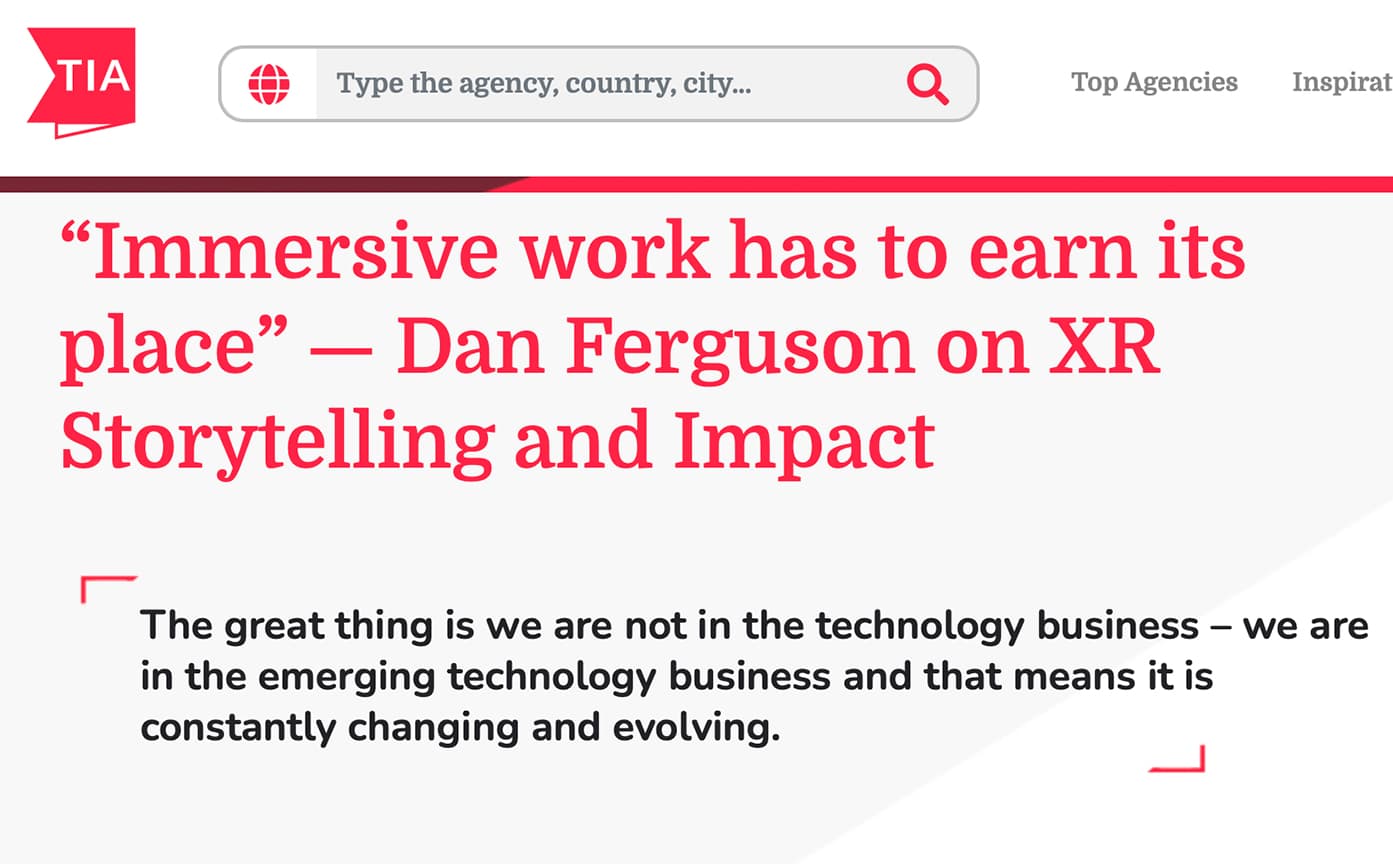
The great thing is we are not in the technology business – we are in the emerging technology business and that means it is constantly changing and evolving. So, we are always evangelizing. Not in the sense of selling the technology, but in helping clients understand the difference between doing something new but doing something meaningful.
Is there a recent project that you feel best represents Groove Jones’ approach to innovation — something that reflects what the studio does at its very best?
A project that really captures who we are is Disasterville. We worked with Team DDB and The Marketing Armfor the Army National Guard. It reflects our belief that immersive technology should have practical value and emotional weight, not just novelty. Disasterville transforms high school gyms into full-scale simulated disaster zones using advanced mixed-reality technology typically found at high-end amusement parks. The activation places students at the center of simulated Guard missions like flood rescues, firefighting, and earthquake relief, giving them the opportunity to experience the Guard’s work first hand instead of just hearing about it.
What makes it stand out is the blend of storytelling and utility. The world is rich and cinematic, but every detail is there for a reason. You step into a real-world mission. It feels intense, but it also teaches. Students come out of it with a clearer understanding of what the National Guard does. Link to the work – https://www.groovejones.com/disasterville-mixed-reality-experience-army-national-guard
Producing immersive work often requires collaboration across many skill sets: designers, developers, 3D artists, strategists, storytellers. How do you build creative culture inside a multidisciplinary team?
Building a strong creative culture starts with respect for what each discipline brings to the table. Immersive work is never the result of a single craft. It is the sum of many perspectives. When people understand that their contribution is both unique and essential, collaboration becomes natural rather than forced. We still come to the office even if half out team is not in Dallas. But when it comes time to test and evaluate, we often fly in team members.
We make space for shared problem solving. Designers, engineers, 3D artists, producers, and strategists all weigh in early. That mix of voices improves the work and builds trust.
We also try to maintain an environment where curiosity is valued. The technology in our field changes constantly, so we encourage experimentation, internal prototyping, and ongoing learning. People feel energized when they can explore and stretch their craft without fear of failure.
We try to keep the culture grounded. Clear communication. Honest feedback. A shared understanding that the best idea wins, no matter where it comes from. When the team feels ownership of the final experience, the work gets better and the culture strengthens. It is not about creating a perfect system. It is about building a place where talented people can bring their full selves to the process and feel supported as they push the boundaries together.
For companies considering XR for the first time, what common misconceptions do you see?
One of the biggest misconceptions is that XR automatically delivers impact just because it is immersive. The reality is that the medium only works when the purpose is well defined. XR is not a magic wand. It will not fix a weak idea or unclear objective. Another misconception is that it has to be huge and complex to be effective. Some of the most meaningful experiences are simple, focused, and tightly aligned with what the audience actually needs.
I also see companies assume that XR is a one off event. In truth, it is most valuable when it fits into a larger strategy. If you treat it like a tool that can scale or evolve, the investment makes more sense.
The advice I give is straightforward. Start by defining the outcome you want for the audience. What should they walk away knowing, feeling, or doing that they cannot get from any other medium? Once that is clear, bring in partners early so you can shape the creative and technical approach together.
Last but not least, everyone needs to test and review in the hardware. That means the team AND the client needs to spend time inside the experience themselves.
Looking ahead, where do you see the biggest opportunities in XR — whether it’s in entertainment, training, healthcare, or entirely new spaces?
Training and simulation will continue to grow because the value is so clear. Any field where repetition, decision making, or high pressure environments matter will lean into XR. The same is true for healthcare, where providers can use immersive tools to educate patients, rehearse procedures, or reduce anxiety.
The area that feels most promising is entirely new spaces where XR becomes invisible. Moments where people are not thinking about the device but are simply engaging with information or environments in a more intuitive way. When XR becomes less of a special event and more of a natural extension of how we learn, communicate, and create, that is when its true potential shows up.
I watch and engage with a lot of content in my Apple Vision Pro. We were one of the first studios to invest in a Blackmagic URSA Cine Immersive camera. The content is special and magical and we believe that it is a game changer.
The future will not be defined by one industry. It will be defined by how well XR integrates into real human behavior. That is where the opportunity lives.
Outside of XR, where do you turn for inspiration or to recharge your creativity?
I step away from screens. That is usually the easy reset I need. I spend time outside, and that helps me clear the noise and pay attention to things that are simple and real. I have a killer backyard, BBQ grill, firepit and pool. I absolutely love spending time with my family out there. My backyard overlooks a lake and a greenspace. On a beautiful clear Texas night, I can go out and see the stars because we are not in the city center. Being present in nature has a way of reminding you how scale, texture, and movement work without overthinking it, and that shows up in my creative decisions more than people might realize.
Another place I find energy is out in the world, visiting our client activations. I love being on site, watching people walk into something our team built. Their reactions are honest and unscripted. You see what surprises them, what they gravitate toward, and what moments truly land. I am always humbled by that. It reminds me why we put so much care into the craft. Nothing replaces seeing a real person engage with an experience rather than imagining it from a conference room.
And finally, is there a fun story or unexpected personal detail that your team or clients might not know about you?
I have so many crazy stories to tell. But one of my favorites was when I was helping create a series of games for the Star Wars movie Revenge of the Sith. We got to go out to Skywalker Ranch to read the script so we could design the games. We were out there for a few days. I got to sleep in Stephen Spielberg’s bungalo. It was a dream come true. When we were designing a game that featured building light sabers, we asked Lucasfilm for some Jedi Knight names. They were so busy with making the movie they told us to submit some names, and they would decide on which ones we could use in the game. One of the names we submitted was “Dando Urguson”which is a play on my name Dan Ferguson. Well, they ended up approving my name and told me they added it to the Jedi Knight names log somewhere in their archives. Which is pretty dang cool in my book.
Check Out the Full Interview
Read the full article here: https://www.topinteractiveagencies.com/digital/agency/leaders/immersive-work-has-to-earn-its-place-dan-ferguson-on-xr-storytelling-and-impact/