




Team TBWA and TMA partnered with Groove Jones to create U.S. Army Drone Racer, a portable multiplayer arcade experience designed to introduce young adult recruiting prospects to Army drone operations through fast, approachable competition. The activation paired accessible controls with adaptive single-player AI, synchronized multiplayer racing, and a persistent leaderboard designed to encourage repeat play.
Groove Jones brought experience from competitive racing games, flight simulations, and motion-tracked activations, giving the agency team a proven foundation for the concept and its technical delivery.
The design premise was simple: the audience would not be won over by novelty alone. The game needed to reward mastery, faster times, and direct competition while remaining approachable for a first-time player.
The Challenge: Authenticity Without Sacrificing Playability
The real difficulty wasn’t designing drones or building a racetrack. It was holding two competing demands at once: the game had to represent the Army authentically enough that it wouldn’t feel disrespectful or cheap, while staying fun and approachable enough that a teenager who has never touched a flight stick could successfully pick it up in a session and want to play again.
Every visual asset in the game, uniforms, vehicles, environments, had to be Army-approved, turning what would normally be a straightforward art pipeline into an approvals-heavy production. And the client’s day-to-day requests sometimes pulled in the direction of realism at the expense of playability.
Designing Flight Controls for First-Time Players
Flight controls had to be simple without becoming a toy. Piloting a drone convincingly is mechanically complex, and the target player had likely never done it. The team tested five different physical controllers, including remote controls modeled on real drone transmitters, before settling on a standard Xbox controller as the best fit for a general-audience arcade experience.
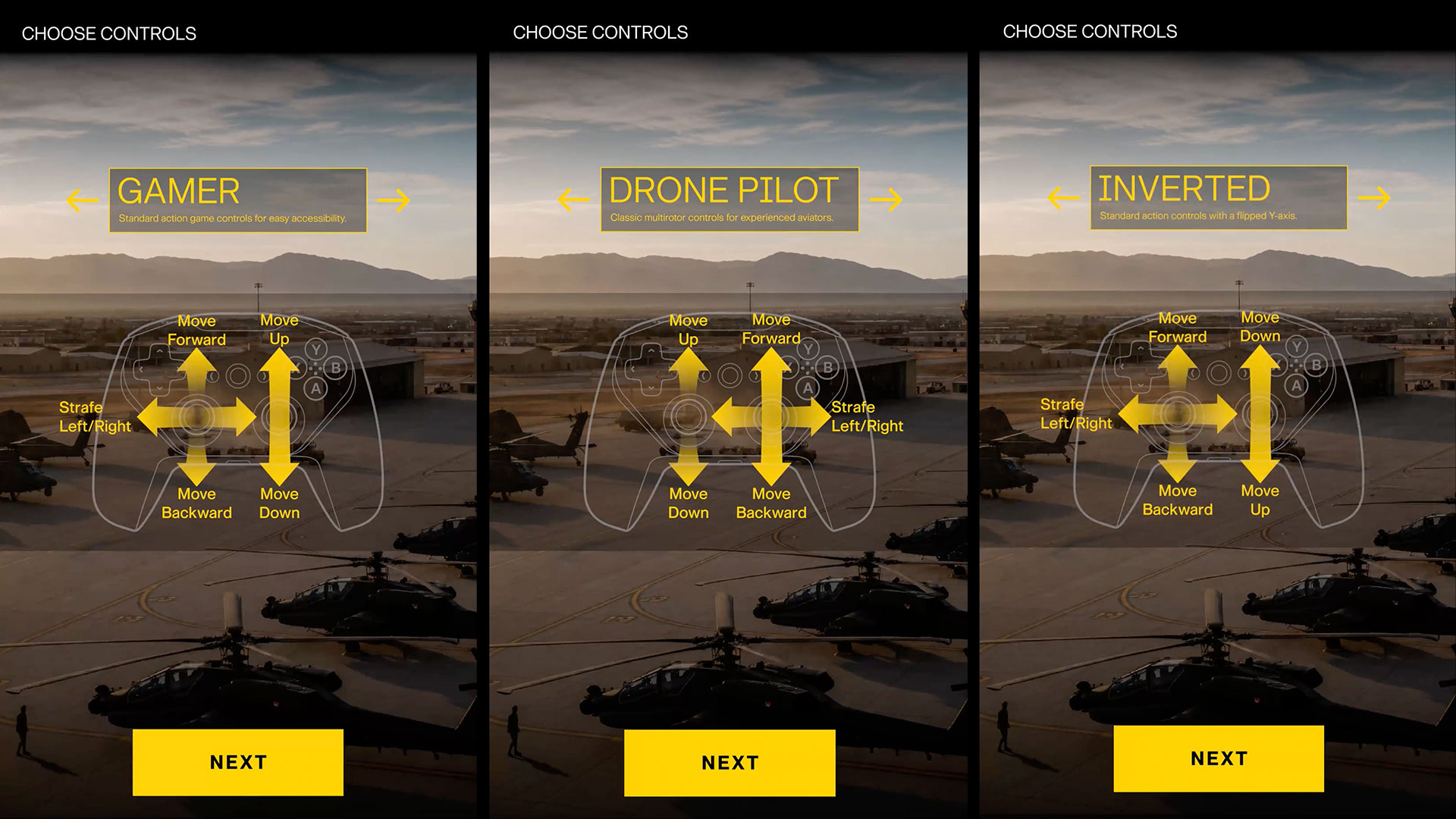
Three separate control schemes shipped in the final build: a default “Gamer” scheme with Y-axis-up controls suited to younger players, an “Inverted” scheme with Y-axis-down for flight-sim veterans and older gamers, and a “Drone” scheme modeled on an actual drone remote for players who wanted the real thing. Players could test each scheme before committing to a run.

Speed had to be dialed down from what felt objectively impressive to what felt fun. Early builds ran drones at 80 mph, which looked and felt great but was inaccessible to first-time players. The team brought it down to roughly 60 mph, the point where speed was thrilling without punishing newcomers.
Adaptive Single-Player Gameplay
Difficulty had to scale to the player, not the other way around, when playing single player mode. Rather than a single fixed difficulty curve, the team built adaptive AI racers that read a player’s pace in real time; a slower player faced a slower field, a faster player faced tougher competition. Course layout reinforced the same idea: the main line through each track stays forgiving, while speed boosts sit in riskier, harder-to-reach spots reserved for players chasing leaderboard times.
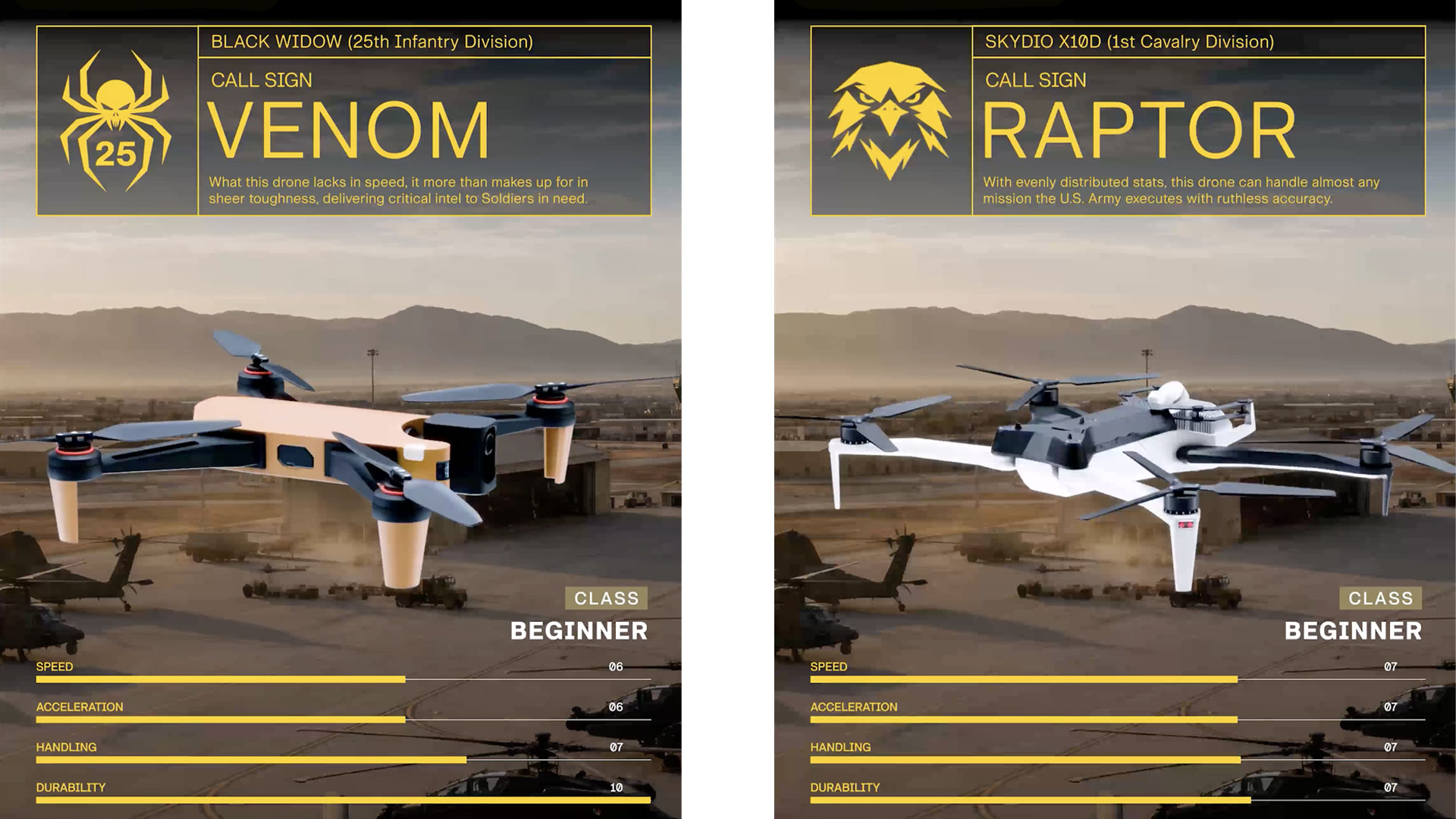
Four playable drones carry the same risk-versus-reward logic through into equipment choice. Venom, the beginner drone, trades top speed for the best acceleration and the most forgiving handling.
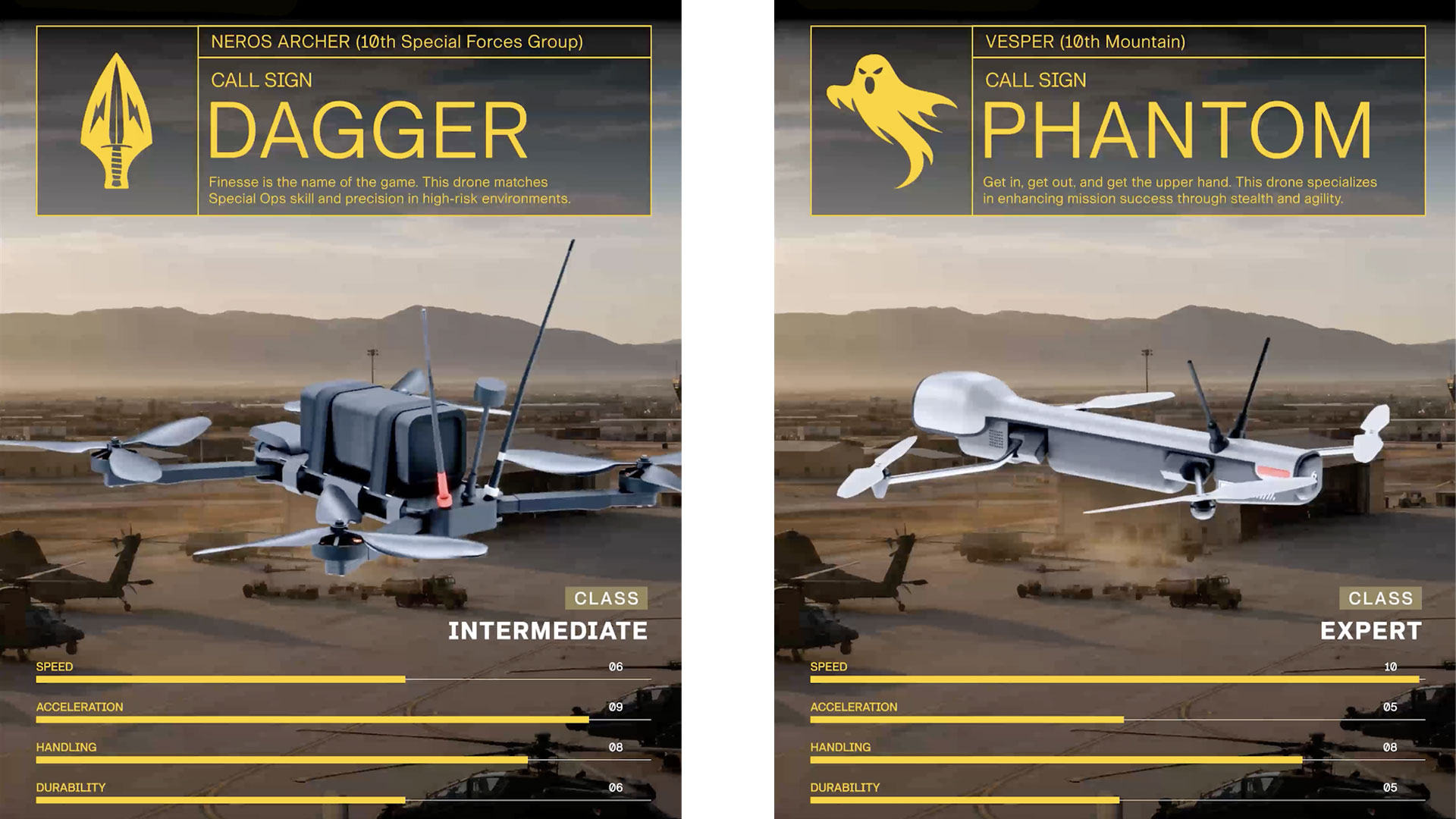
Phantom sits at the other end: high top speed, low acceleration, and difficult enough to steer that it’s effectively required to post a top leaderboard time. Raptor and Dagger fill the middle ground. The team assigned and re-tuned these stats iteratively as a group until the beginner-to-expert labeling matched how each drone played.
Offline Multiplayer and Synchronized Physics
Multiplayer was the single hardest technical problem on the project. The team’s own rule of thumb for any networked multiplayer feature: multiply your time estimate by four. In a racing game specifically, both players have to be looking at the exact same simulation state at the exact same moment, especially at the finish line, or the race stops being fair and stops being fun. The team built upon Photon Fusion (their second project using it, after previously working with Photon PUN) and layered in predictive, client-side physics that look ahead and reconcile against the host’s simulation.
A new wrinkle this project introduced that prior Groove Jones racing games hadn’t attempted: full physics-based collisions, with terrain and with other players, which multiplies the reconciliation problem across the network. Because the installation has to travel to venues that may not have reliable internet, the whole system runs on an offline, local Photon server, coordinated by Groove Jones’ own matchmaking and “showrunner” backend service that keeps every cabinet’s game state in sync.
The Build
- Engine: Unity, running the High-Definition Render Pipeline (HDRP), the same pipeline the team first put into production on Bird Flight and later reused on Invesco Financial Racer. HDRP trades the performance ceiling of Unity’s Universal Render Pipeline for AAA-grade lighting, bloom, and HDR effects, a tradeoff the team could afford because the cabinets run on dedicated high-end PCs rather than mobile or VR hardware.
- Networking Multiuser Play: Photon Fusion for host/client reconciliation, running against an offline local Photon server so the installation works without a venue internet connection.
- Track System: A bespoke, spline-based bounding-box and track system built from scratch for this project, paired with a matchmaking layer adapted from the Invesco Financial Racer system but rebuilt as close to net-new.
- Backend: GrooveTech, the studio’s internal, reusable service layer covering version tracking, service location, and matchmaking, carried forward and hardened across multiple previous producitons.
- Human-Directed AI-Generated Cinematics: Every mission opens and closes with a rendered cinematic, the drone launching off an assembly table or out of a hand at the start, landing again at the finish. The team fed screenshots of final in-Unity art into the AI video tool Krea to generate the transitions between real gameplay and cinematic, then had an artist manually animate and composite the drone into shots the AI couldn’t carry on its own, before upscaling the final cuts to 4K. Traditional generative AI handled discovery-phase pre-visualization early in the project, establishing the visual direction before a single game asset was built; the in-game AI itself is conventional game AI, steering and pathfinding logic for the adaptive racers, not a generative model.
Two Courses: Training and Mission
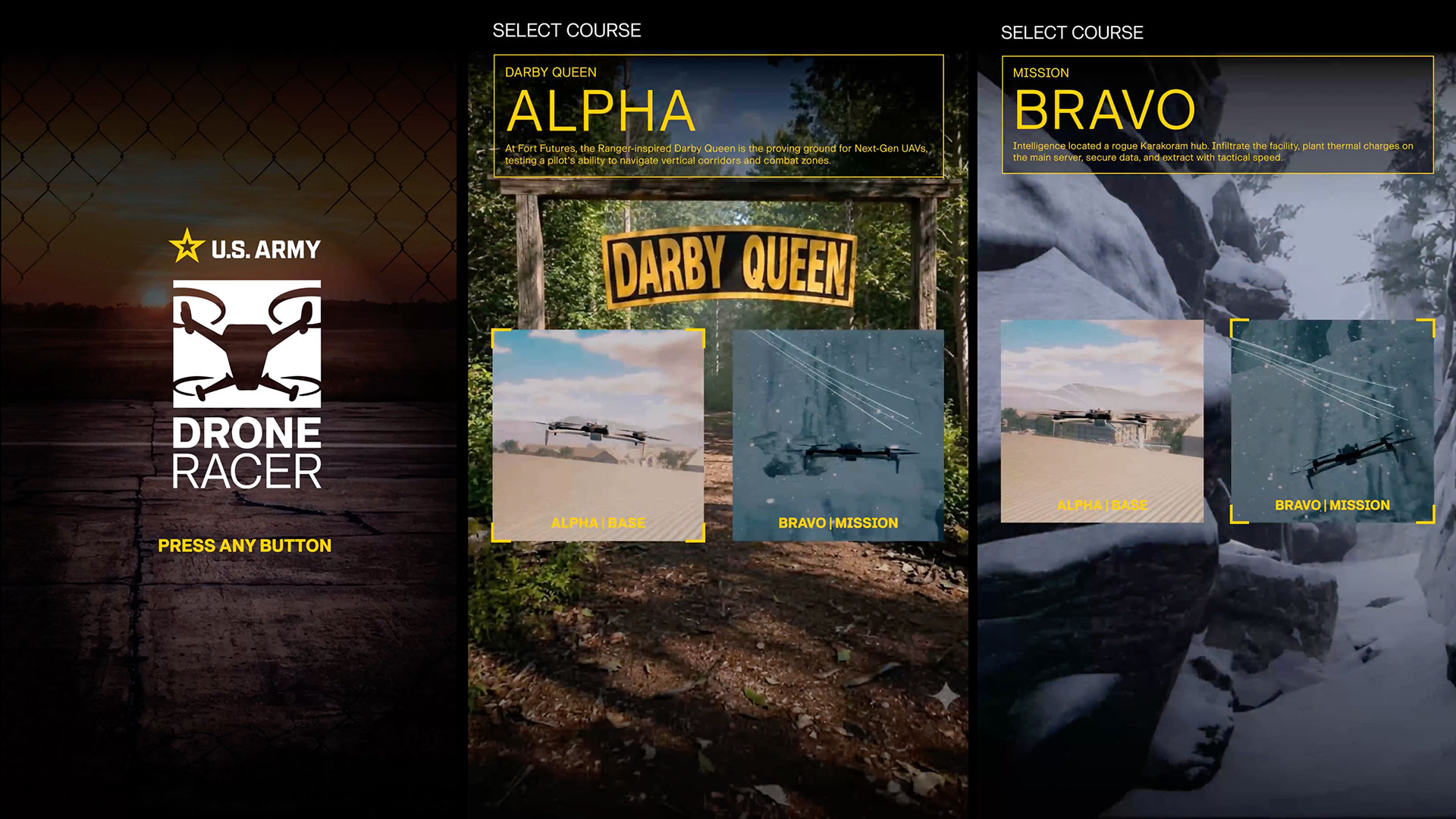
The experience includes two tracks as a matched pair: Alpha teaches you to fly, Bravo asks you to prove it. Track Alpha is the training mission, loosely based on a real Army base installation.
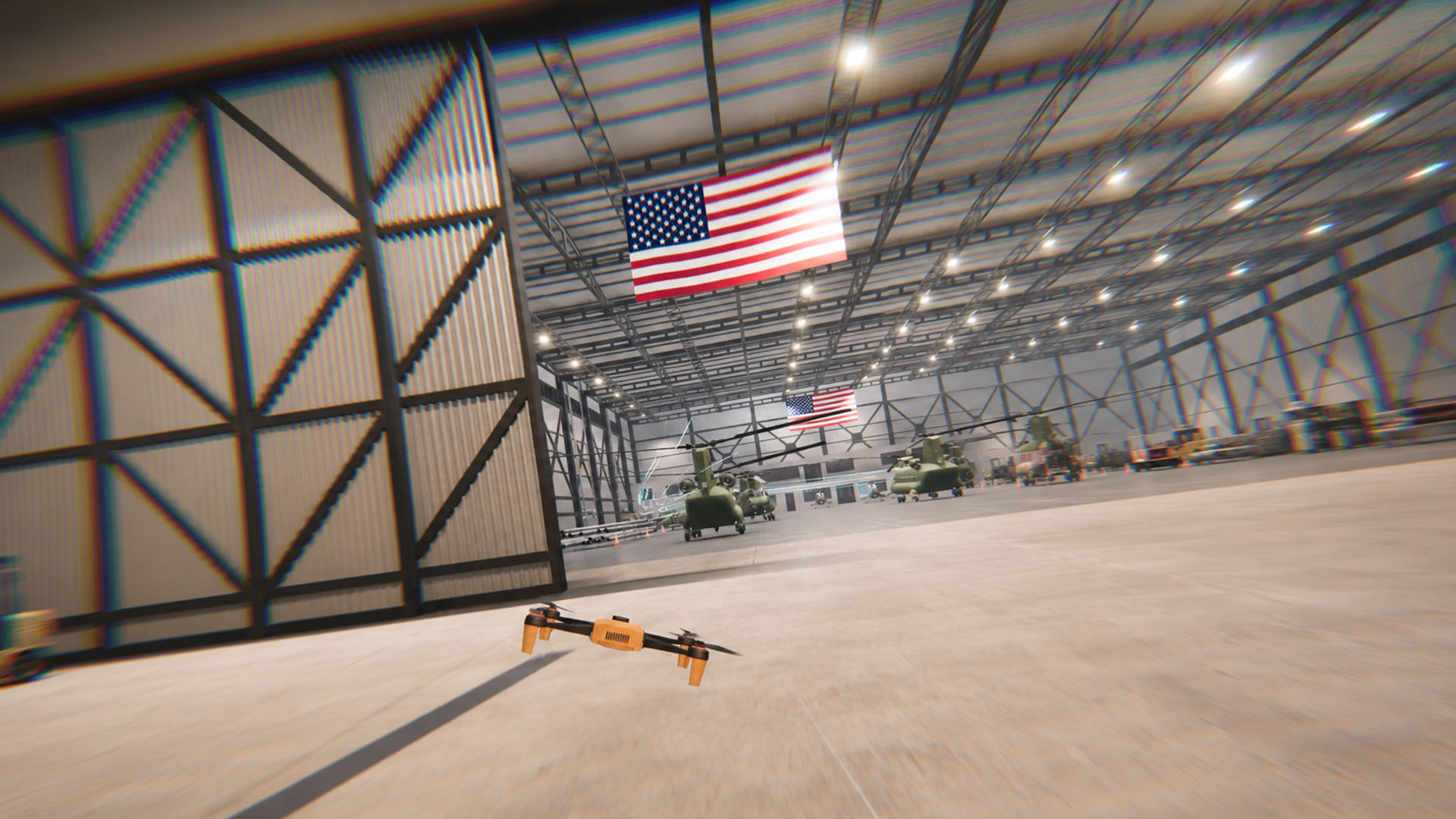
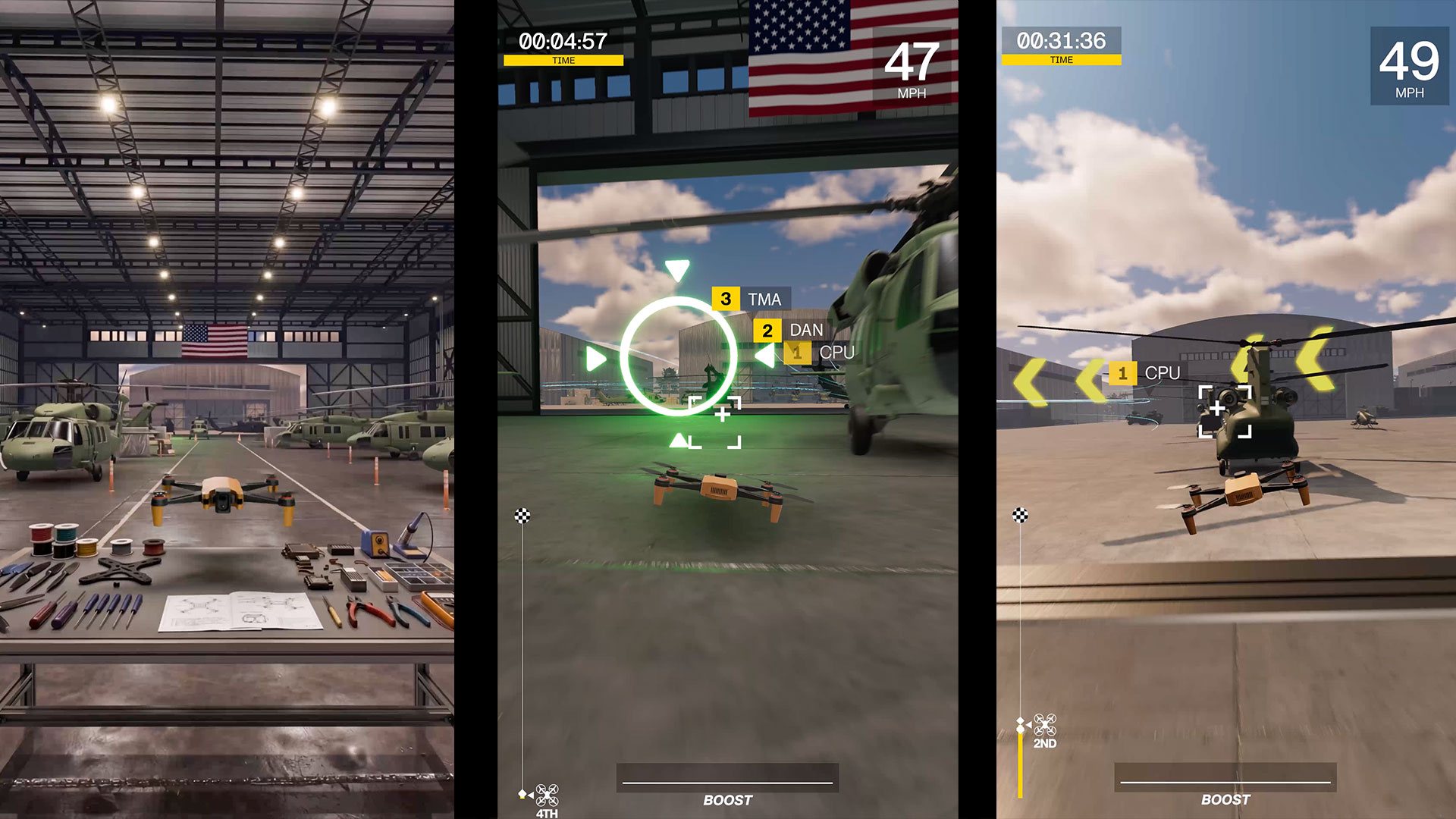
It opens inside a flight hangar, the drone launching off an assembly table, then weaves through hangars and a taxiway crowded with military helicopters and vehicles along an airstrip.
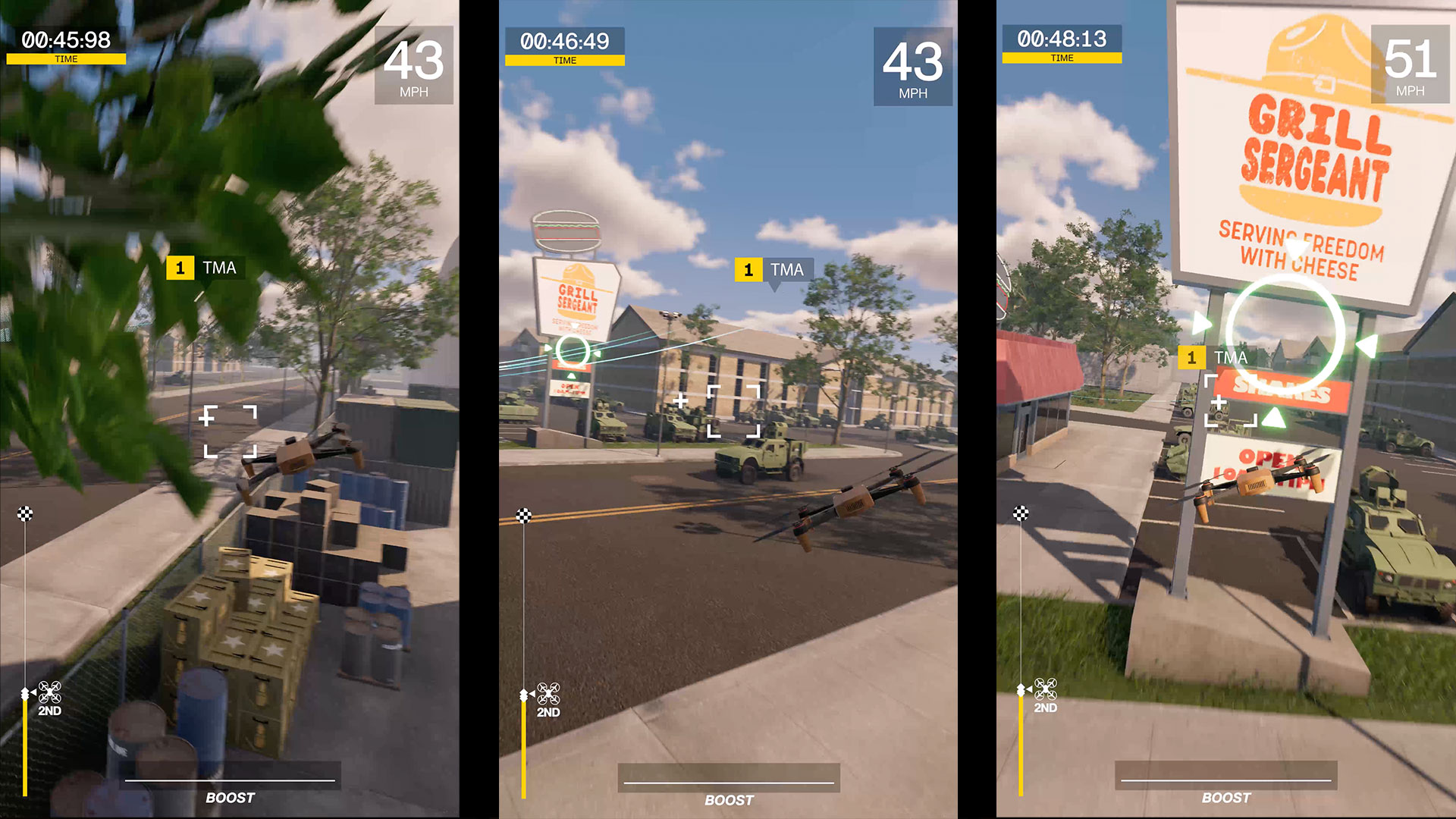
The course takes players behind a series of hangars before passing the Grill Sergeant, an original, burger-inspired fictional restaurant created to give the base more character.
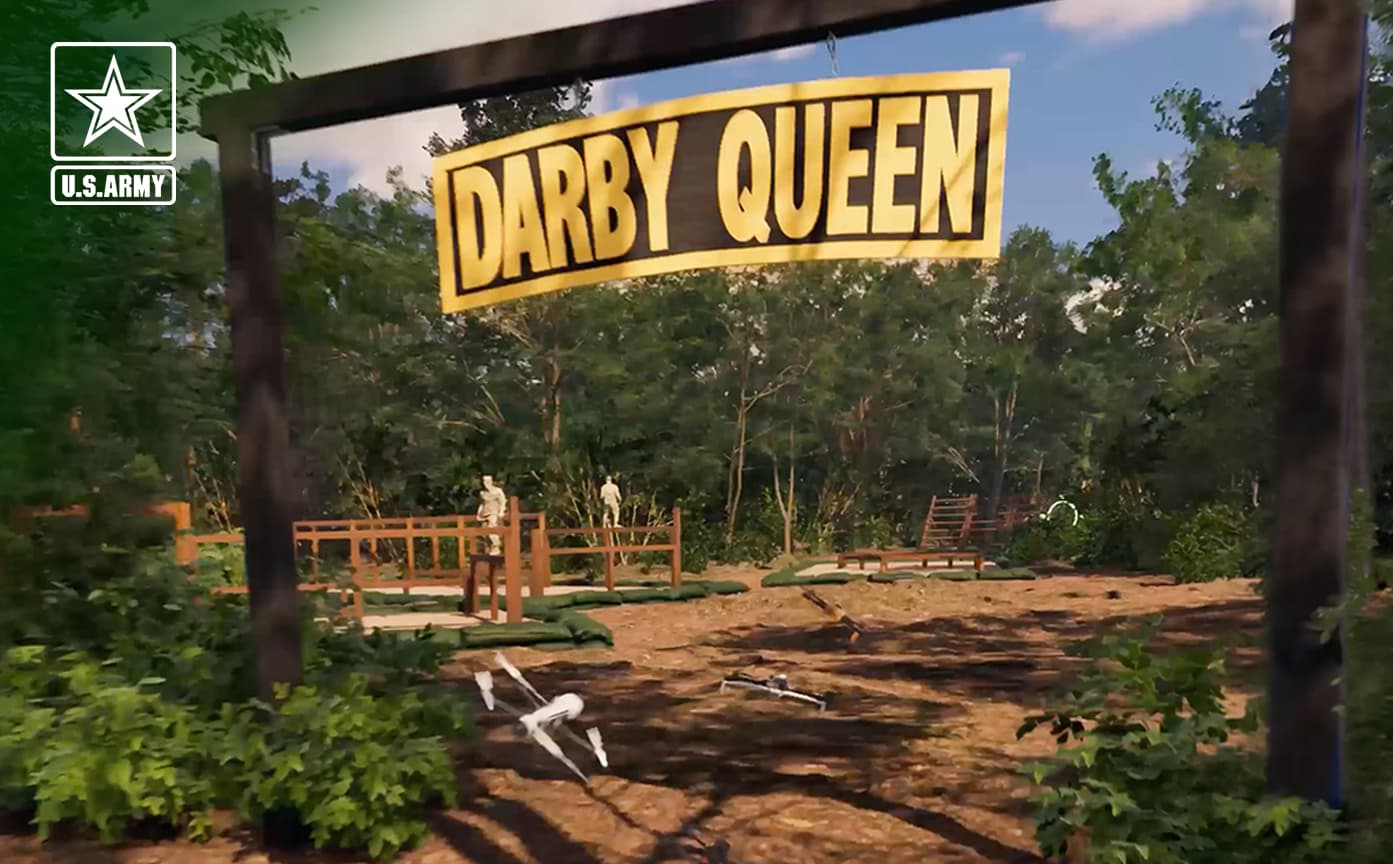
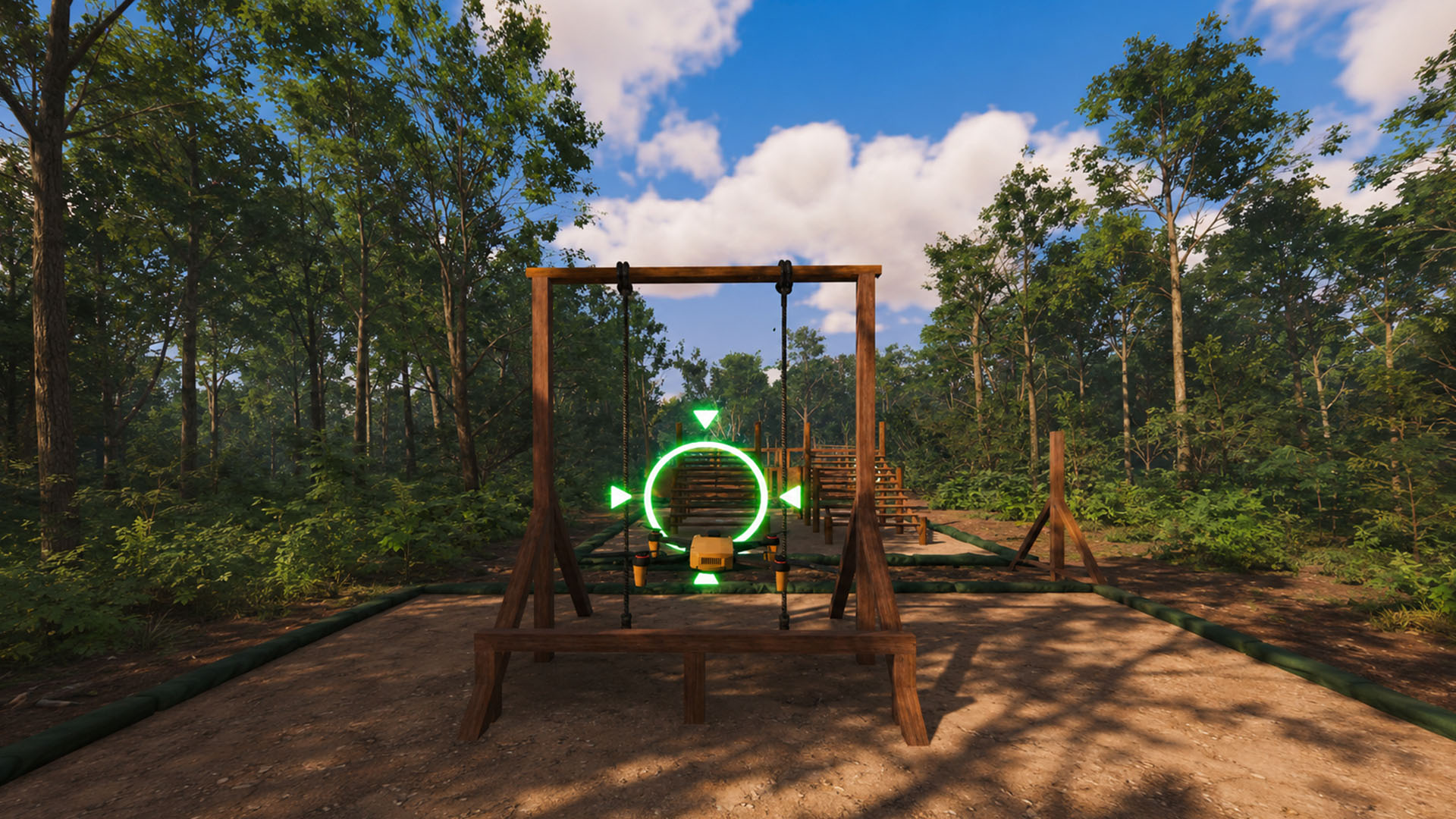
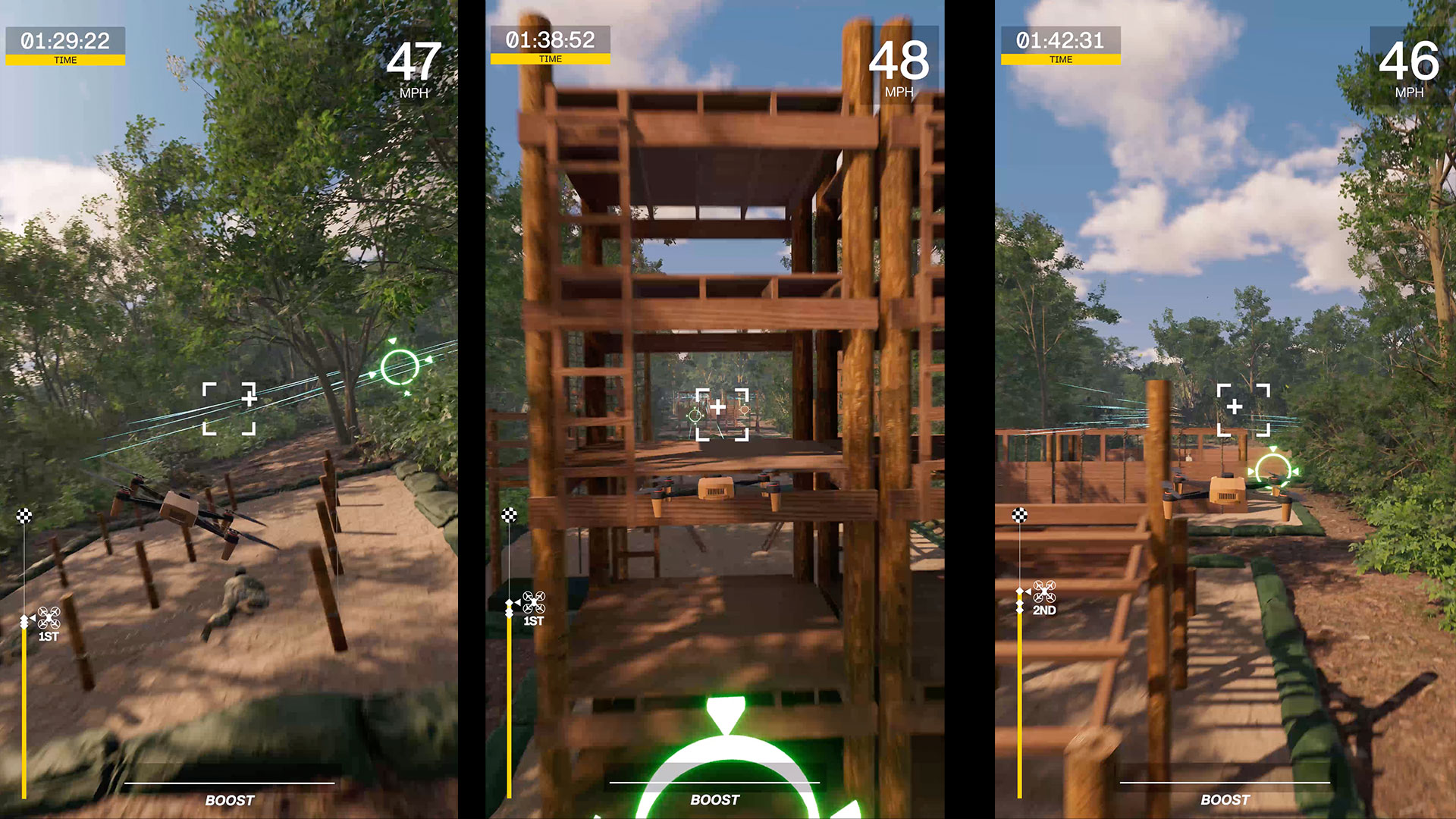
From there, the course crosses a parade ground with marching soldiers before entering a recreation of the Darby Queen obstacle course at Camp Darby on Fort Benning, home of the U.S. Army Ranger Course.
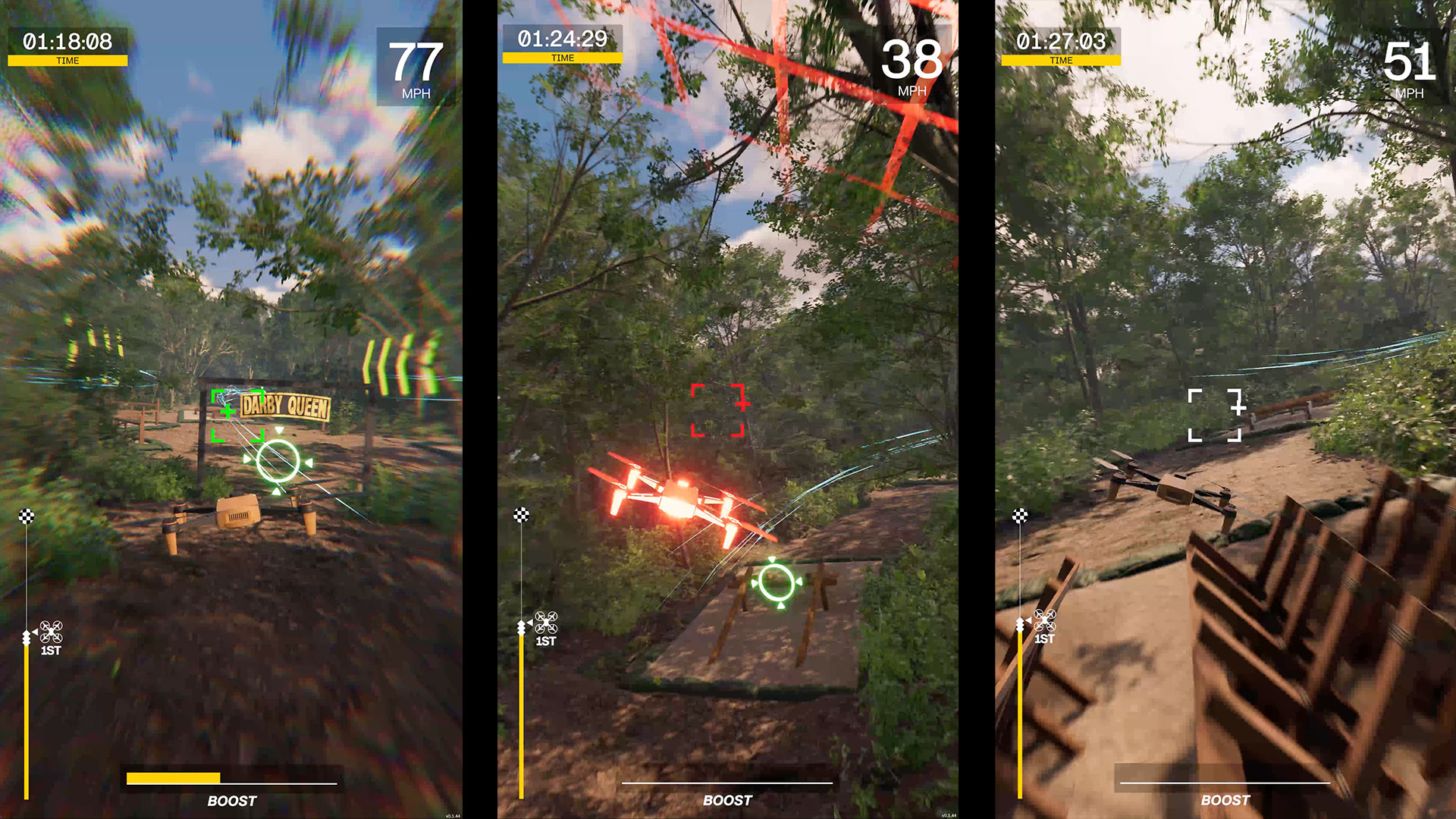
Animated soldiers run the actual obstacles, ropes, climbing structures, and crawl spaces, beneath and around the player’s flight path at the same time the drone is threading through them.
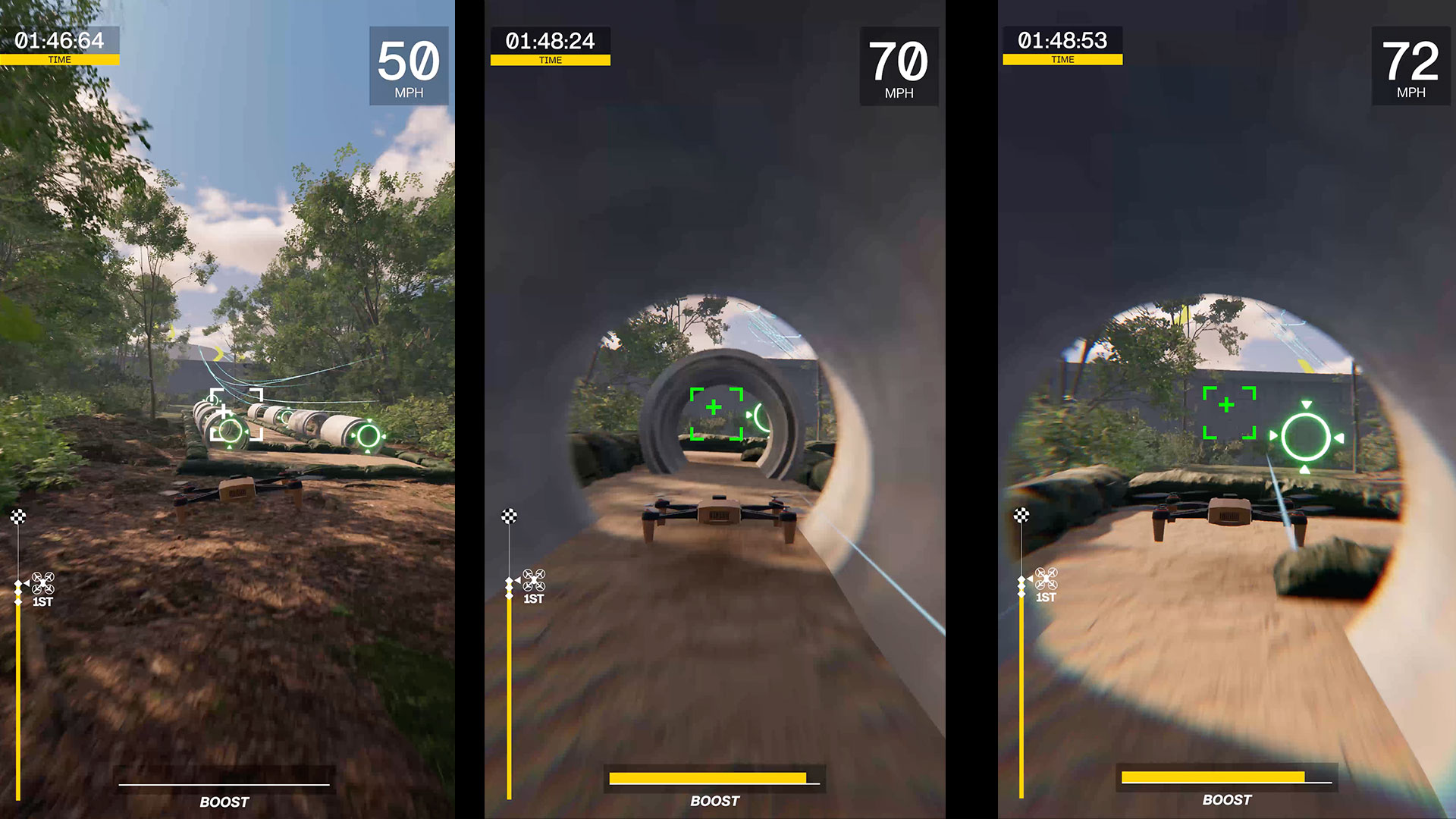
Players can take a higher-difficulty detour through a set of concrete tubes for players chasing a faster time; it’s not required to finish the course, but pulling it off is its own small reward.
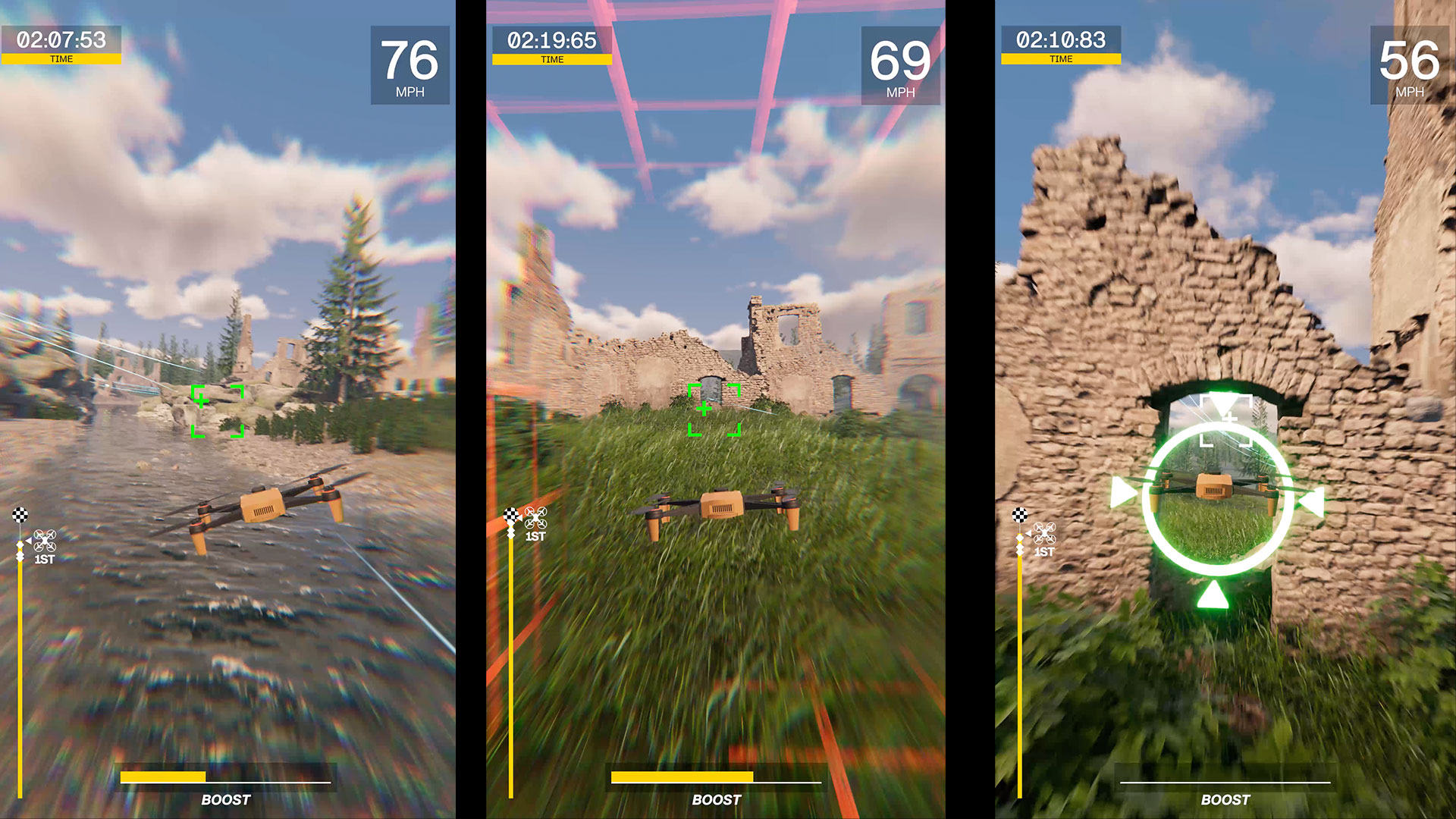
The track closes at a live-fire range, tanks firing on abandoned structures, explosions and flying debris in the air around the drone, closer in tone and pacing to the mission track that follows than anything earlier in Alpha.
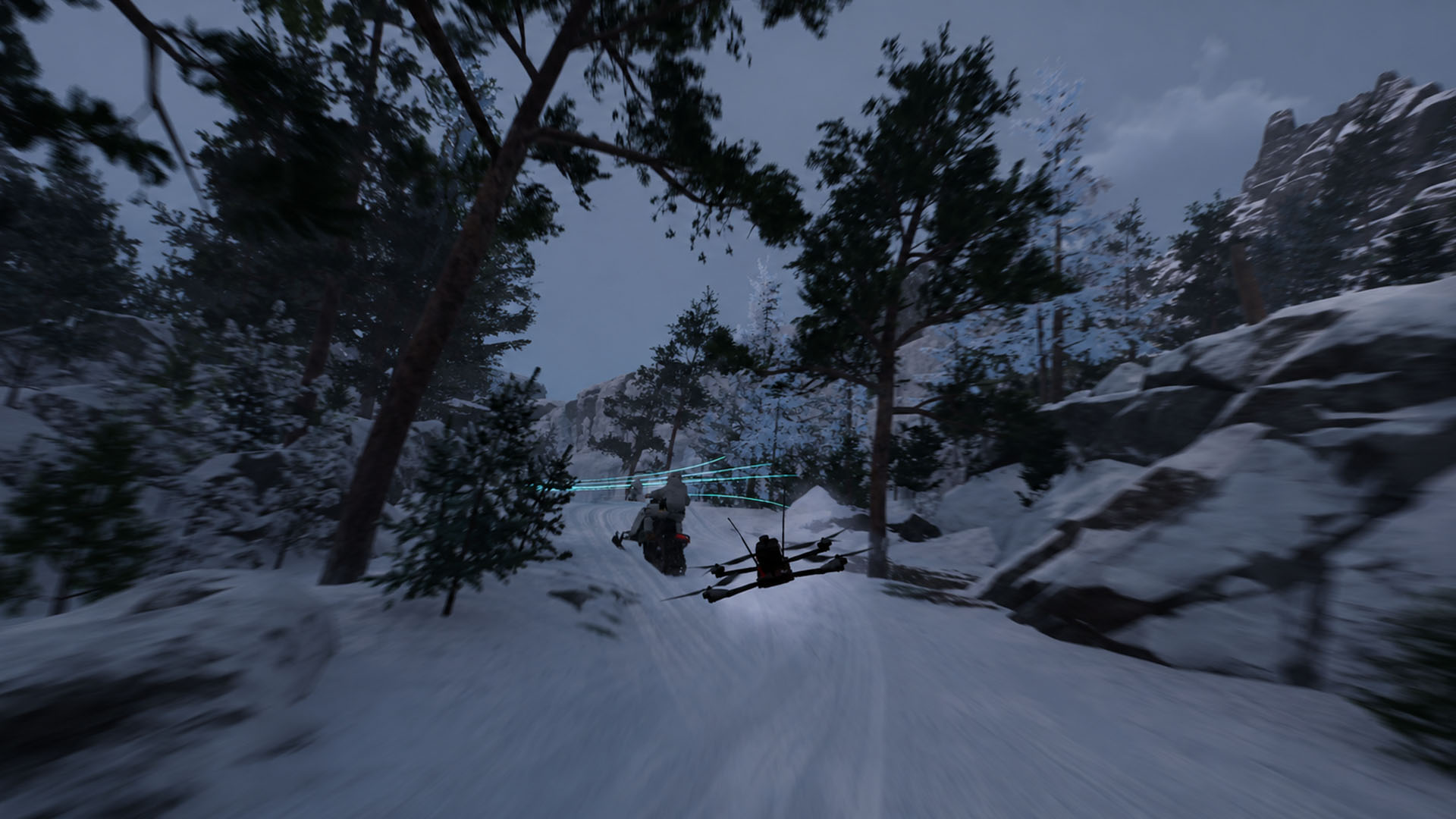
Track Bravo puts Alpha’s training into an actual mission, deploying the player from a Chinook helicopter into a mountain environment to knock out an enemy power station and hand friendly forces a tactical advantage.
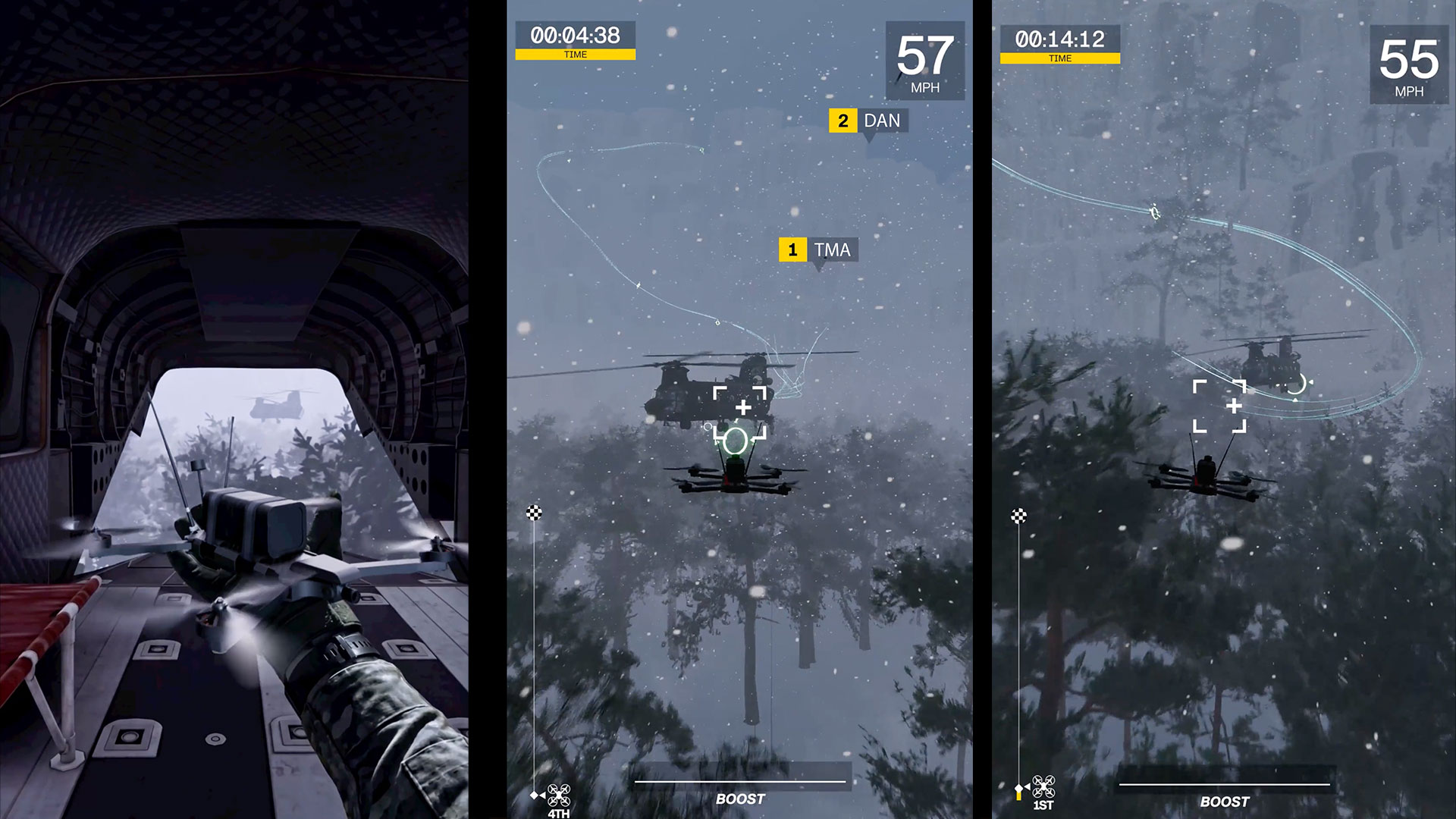
Players launch from inside the Chinook mid-deployment as soldiers rappel out below into the forest, then climb a snowy cliff face where other soldiers scale the rock and snowmobiles cut across the slopes alongside the drone.
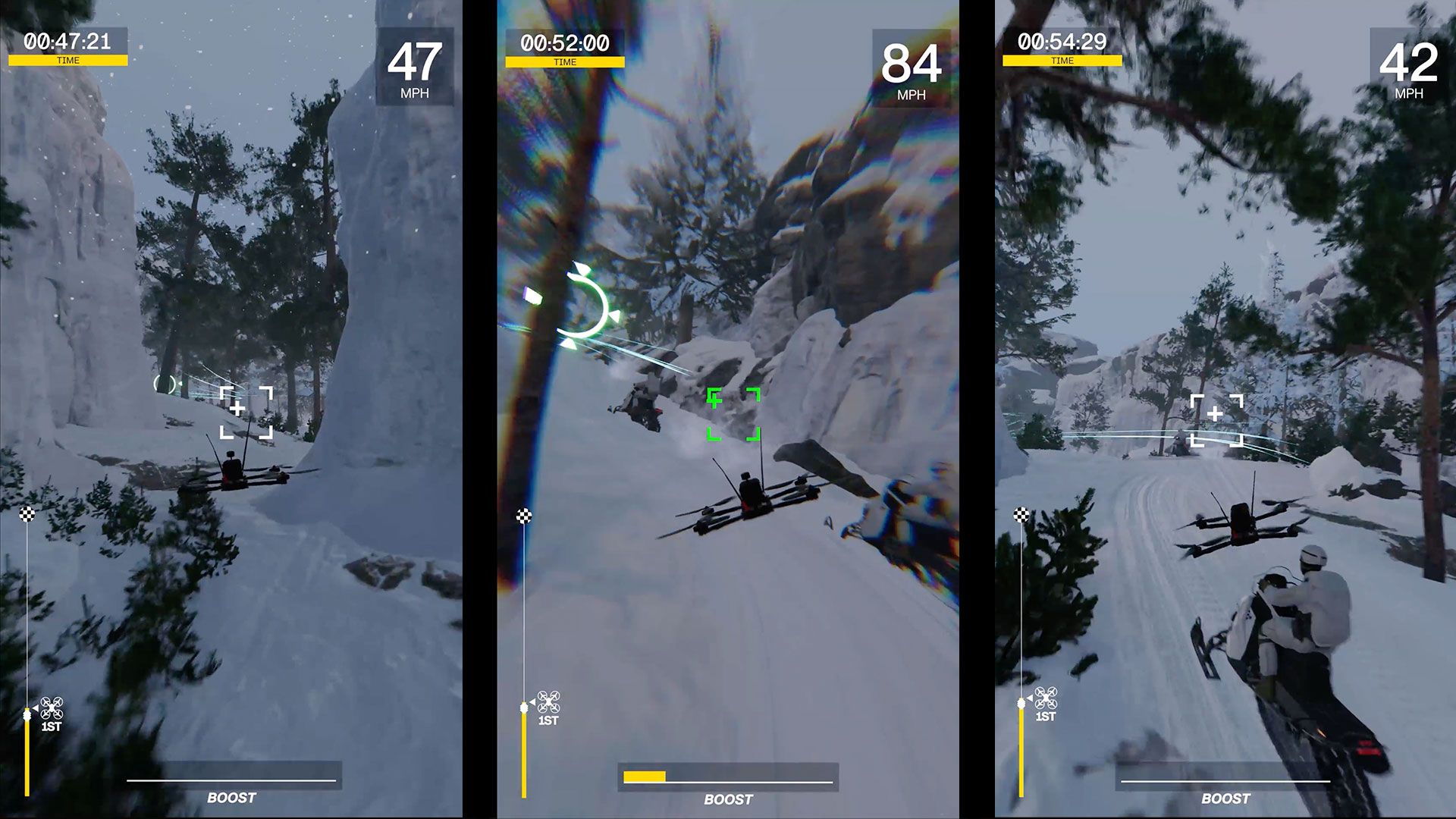
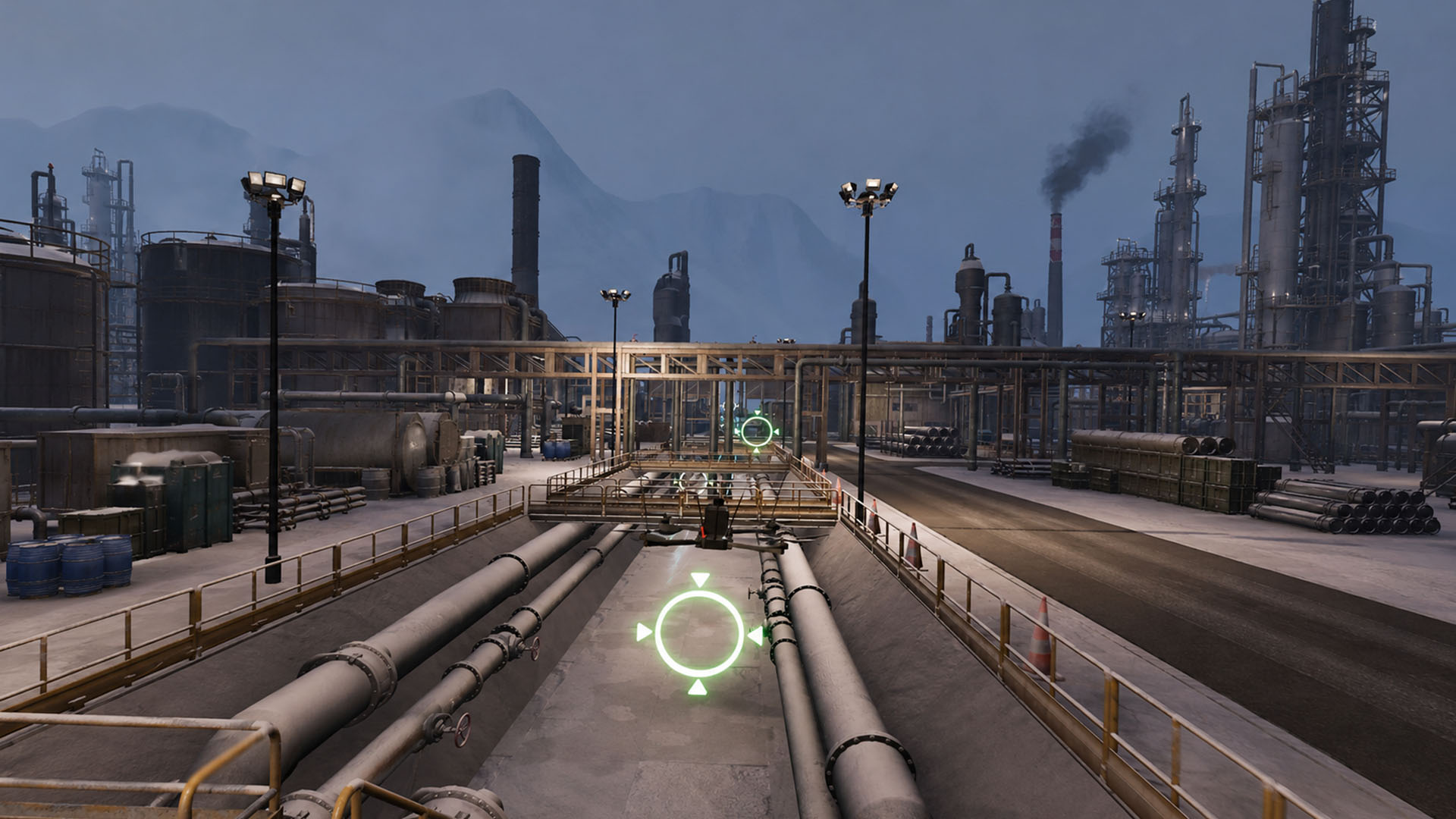
The route reaches an industrial facility as a breach team opens the perimeter wall, sending the player into a tight, high-pressure sequence of pipes and catwalks.
The mission is not a straight race to the finish. The player threads a series of illuminated gates to laser-designate a target for an EMP strike, then escapes through a closing door as the effect detonates behind the drone at the finish line.
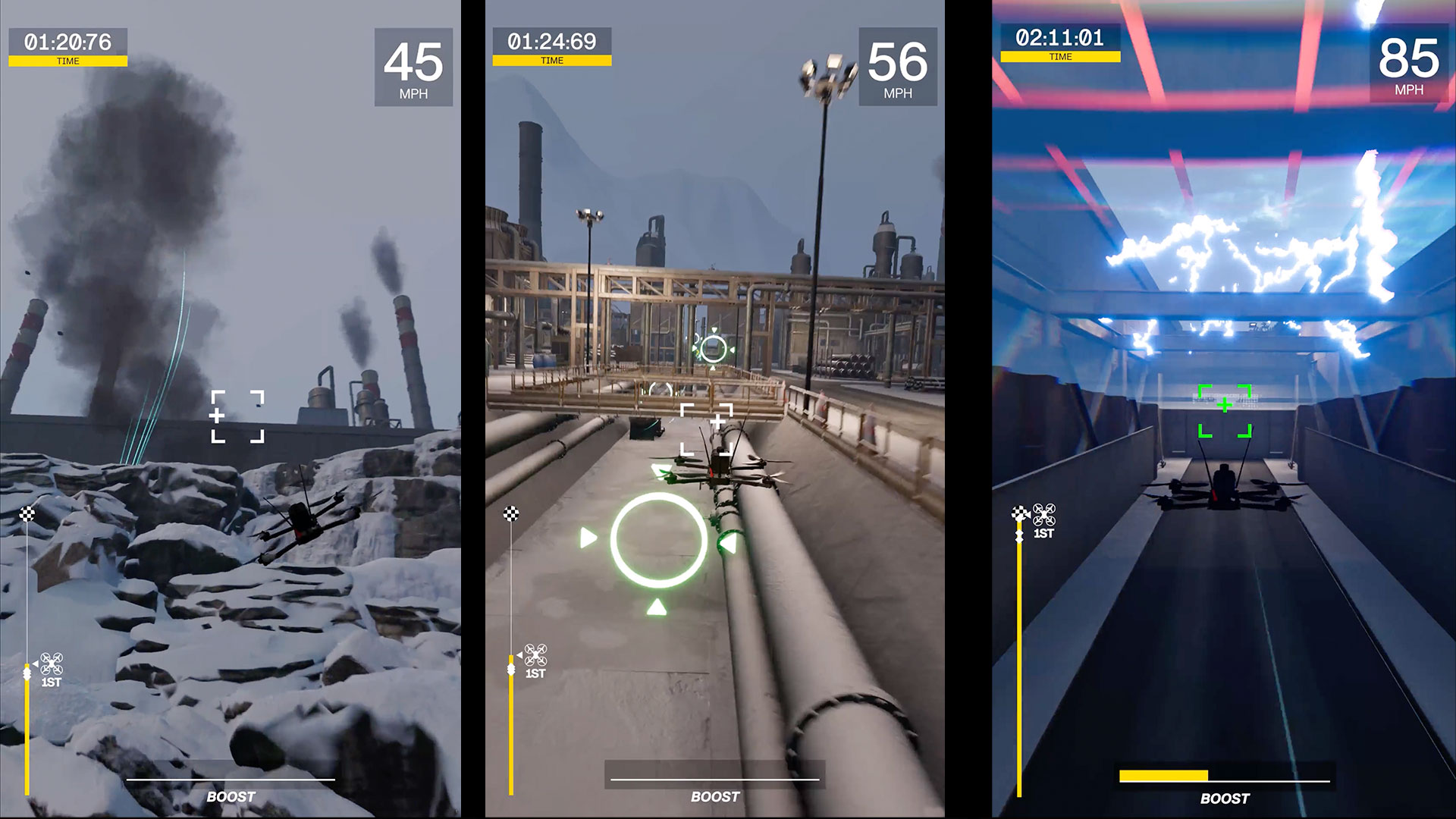
A full run of either track takes roughly two to three and a half minutes depending on skill, with most first-time players landing close to two minutes forty-five seconds; the team’s more practiced players could clear a track in around two and a half minutes.
A Leaderboard Designed for Repeat Play
At the end of each game, players see their finish time, their ranking against friends, and their standing on the event-long leaderboard.
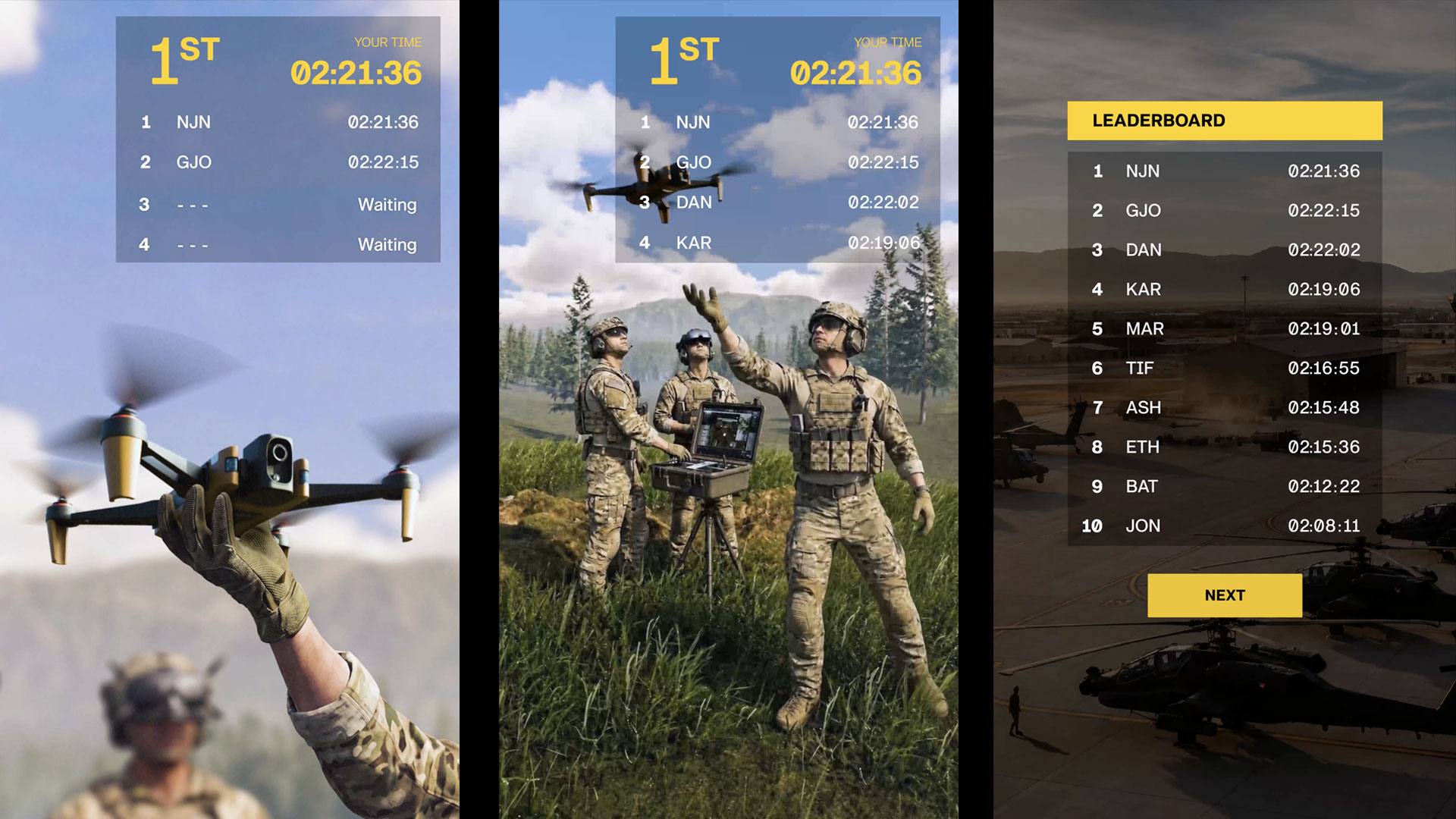
The leaderboard wasn’t treated as a bolt-on feature at the end of production. It was built in as a core design pillar, a persistent, per-track, per-drone ranking system that turns a single five-minute session into an open challenge: beat your own time, beat the person next to you, beat whoever’s initials are sitting in first place today. That single mechanic, more than any visual flourish, is what turns a one-and-done demo booth into a line that reforms itself, because nobody wants to walk away from a top-ten slot without seeing if the next person can actually take it.
Portrait 4K Cabinets Built for Flight
The cabinet itself is worth dwelling on, because the design decision at its center runs against how almost every racing or flight game gets built. Racing games live in landscape: wide fields of view, horizon lines, mirrors at the edges of the screen.
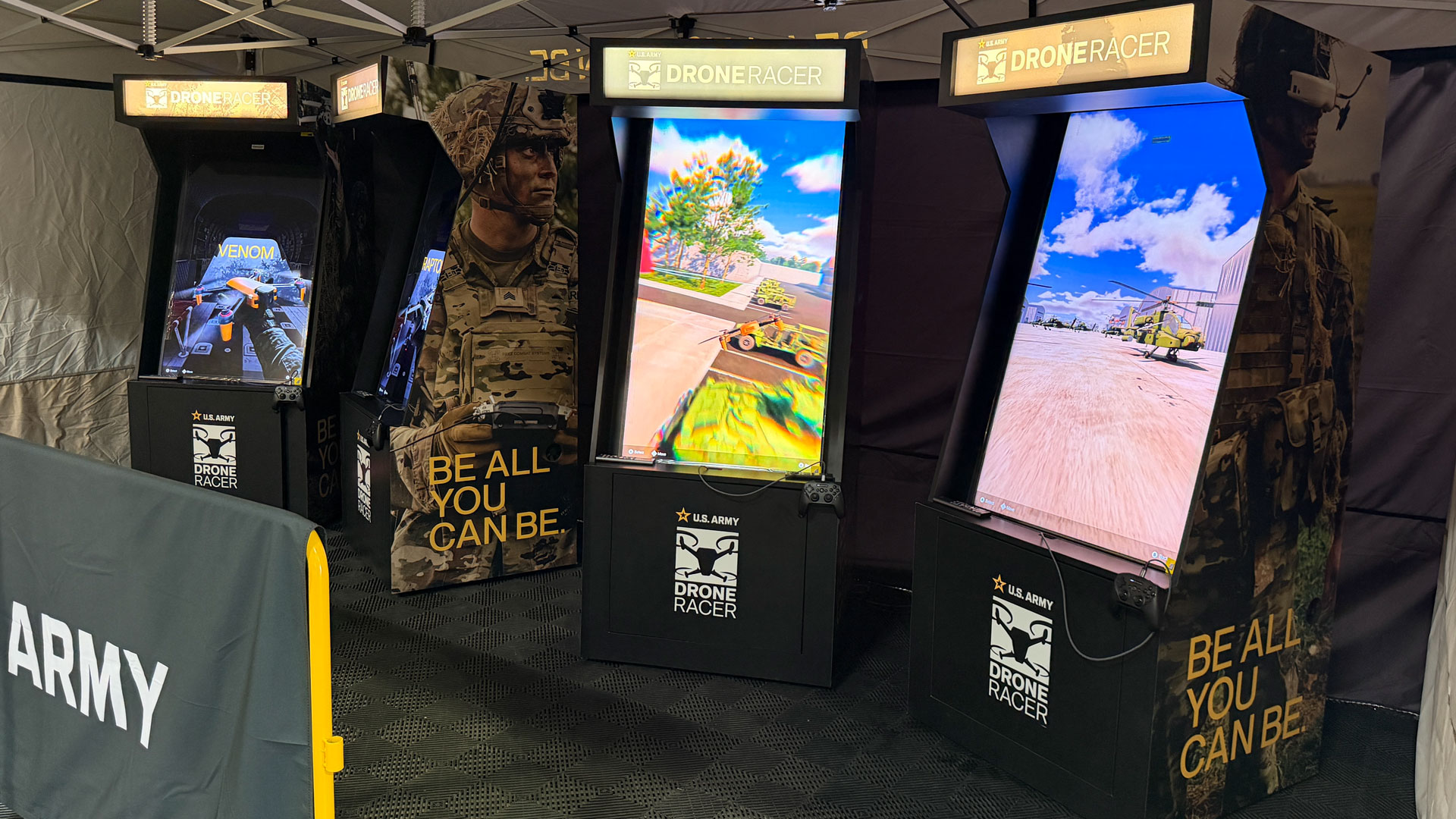
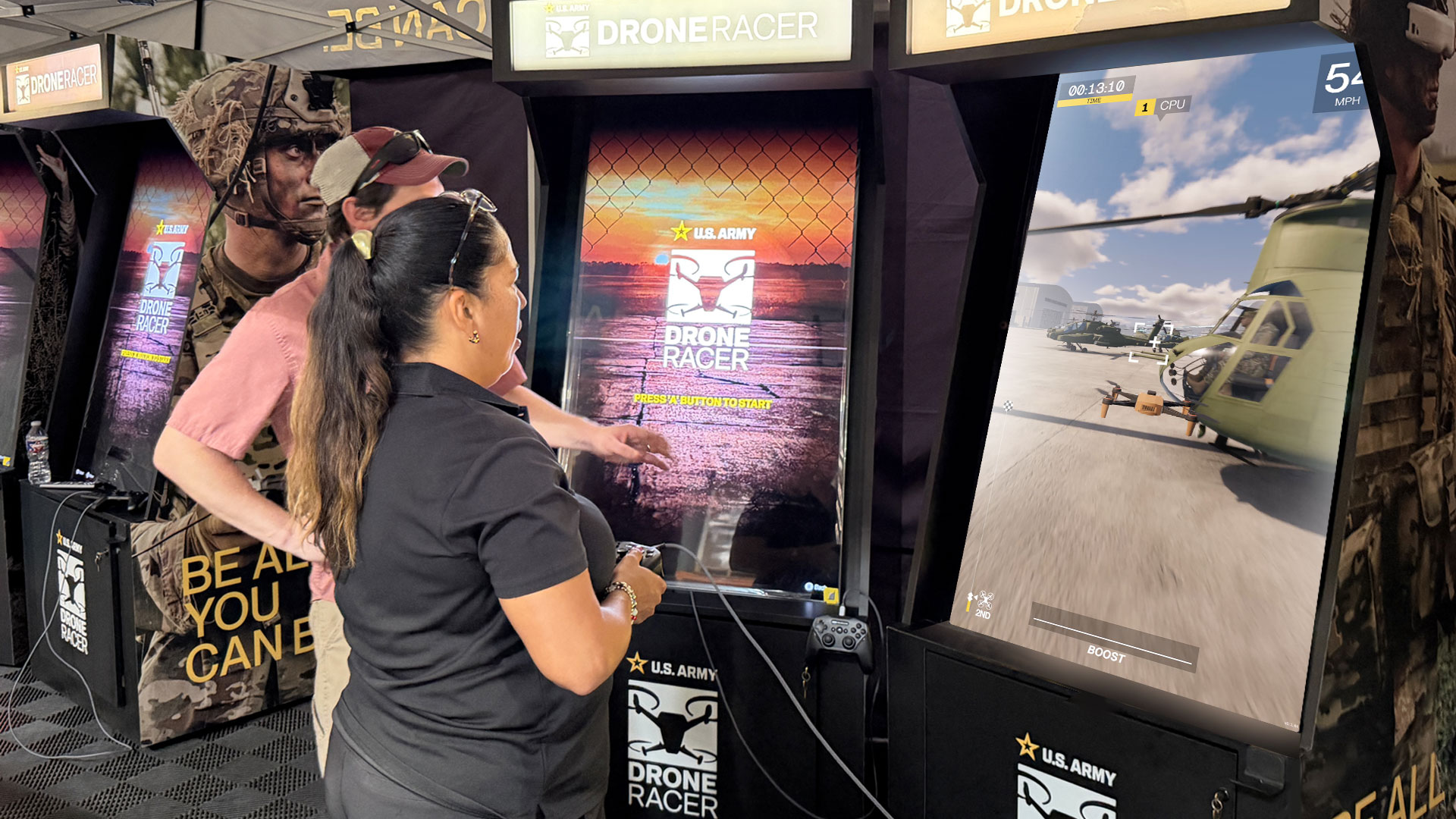
Army Drone Racer runs its 4K display in portrait mode instead, standing the screen on end like a classic upright arcade machine rather than a driving cabinet. It’s a small-sounding choice with a real payoff. A drone doesn’t corner like a car; it climbs, dives, and threads vertical gaps between rooftops, cliff faces, and pipe racks, and a tall screen puts that vertical motion directly in front of the player instead of trimming it off the top and bottom of a widescreen frame. It also reads better from six feet away in a crowded tent, where a portrait cabinet with a glowing HUD reads instantly as its own distinct silhouette against a row of conventional landscape kiosks.
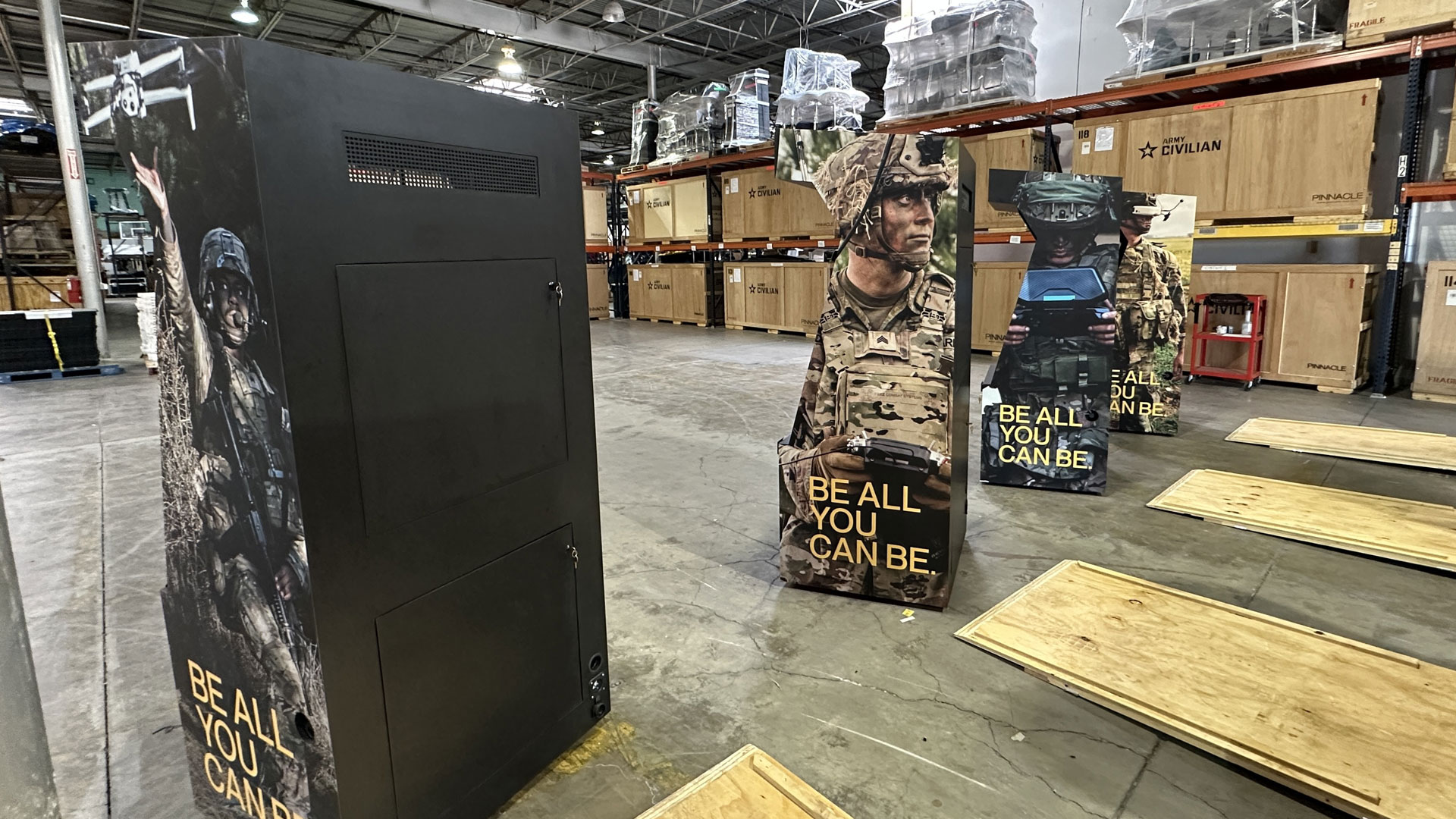
The payoff shows up in the booth photos themselves: the cabinets don’t look like arcade racers at all, they look like something built specifically for flight.
Results and Operational Proof
Army Drone Racer’s first live deployment was at EAA AirVenture Oshkosh. Across the activation, the installation recorded 535 player sessions. At approximately five minutes from walk-up to walk-away, that represents about 45 cumulative participant-hours, excluding spectators. The system experienced no extended outage during the activation.
After seeing the experience in use, the Army reorganized the activation into an education-to-experience journey: real drone hardware, registration, and then gameplay. U.S. Army drone operators also provided positive feedback on the vehicle models and environments, while recognizing that the flight model was intentionally tuned for recruitment engagement rather than pilot training.


