
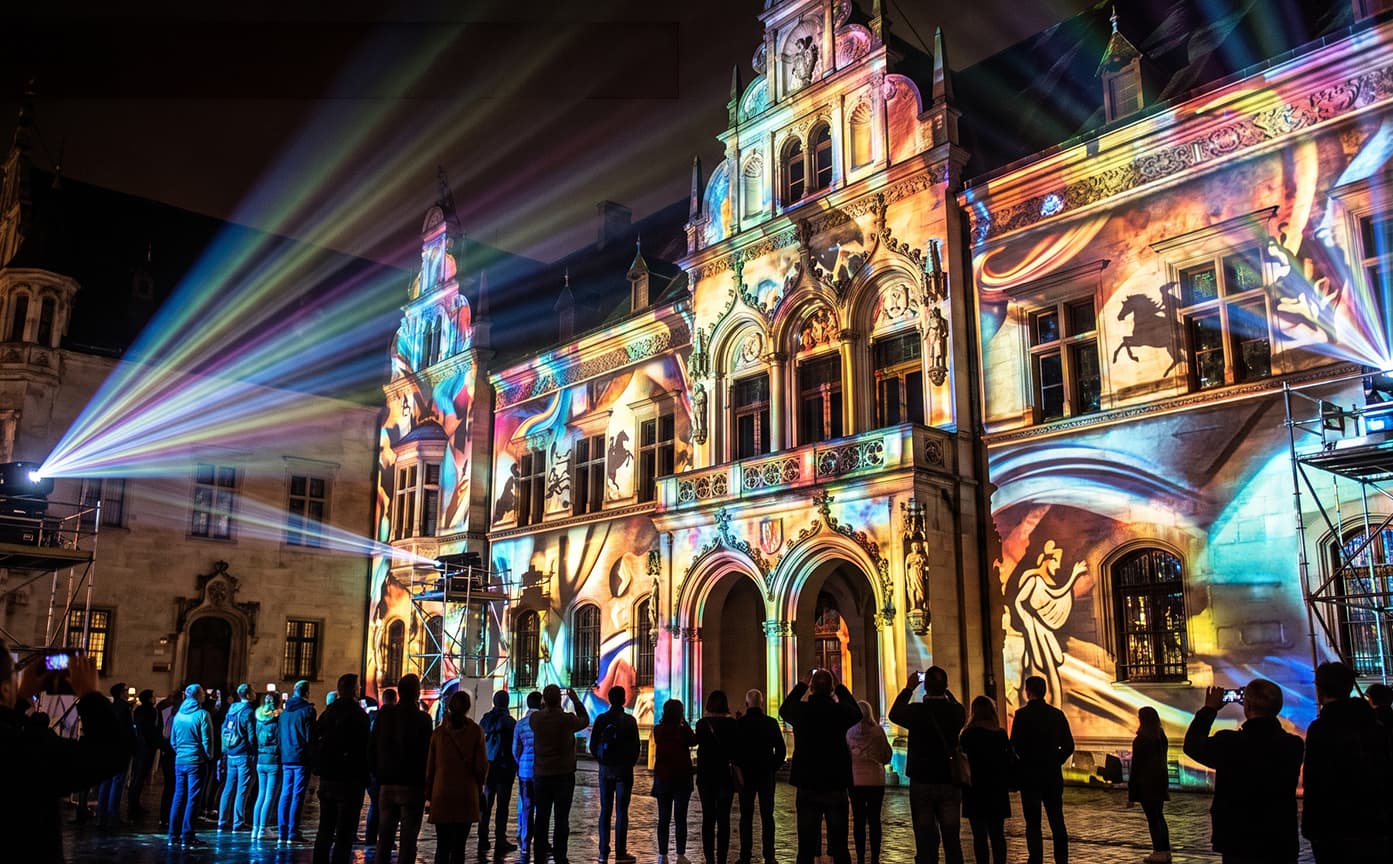




Projection mapping transforms physical surfaces into dynamic visual canvases. By aligning digital content with buildings, architectural details, exhibit walls, sculptures, stages, and other three-dimensional objects, projection mapping can create the illusion that a surface is moving, changing, or responding to the audience.
Unlike a traditional screen, the physical environment becomes part of the creative. Windows can turn into portals. Columns can pulse with light. Museum walls can respond to visitor input. A historic interior can become a continuous animated composition.
In this guide, we explain how projection mapping works, where it is used, what production teams need to consider, and how Groove Jones has applied the technique across brand activations, events, and permanent exhibits.
What is projection mapping?
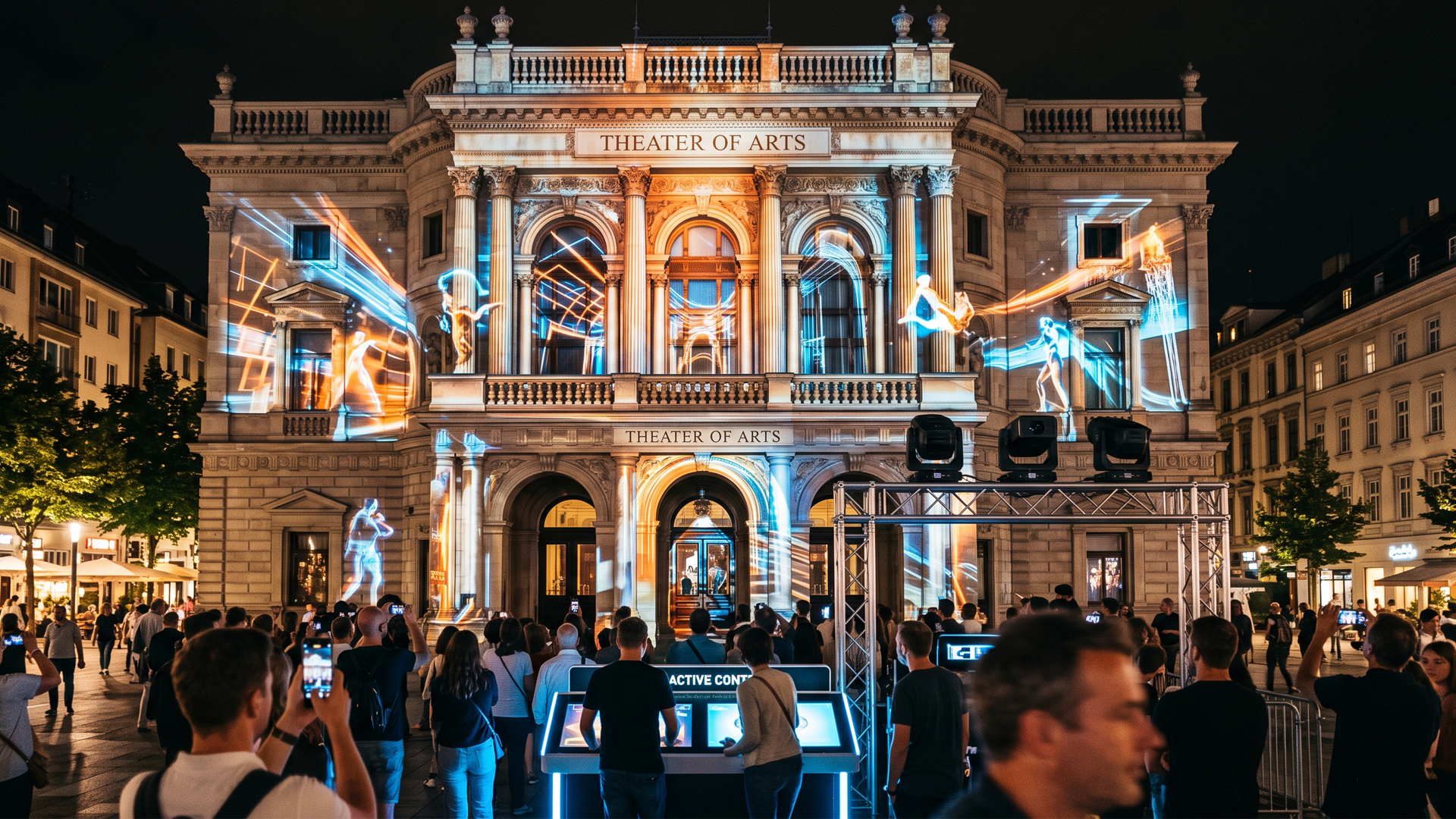
Projection mapping is a production technique that uses projectors to place video, animation, motion graphics, or real-time visuals onto a physical surface. Instead of assuming a flat rectangular screen, artists design content around the contours and architectural features of the target.
The surface might be a building facade, a room, a stage set, a sculpture, a product, or a custom-fabricated installation. When the content and projection system are carefully aligned, the imagery can appear integrated with the physical structure rather than simply projected on top of it.
Projection mapping can be passive, like a looping architectural animation, or interactive. Sensors, touch controls, computer vision, or other inputs can allow an audience to influence the projected content in real time.
How does projection mapping work?
Although every production is different, most projection mapping projects involve five connected stages.
- Define the story and audience: The team first determines what the experience needs to communicate, who will see it, where they will stand, how long they will engage, and what role the physical environment should play in the story.
- Map the surface: The production team builds an accurate digital reference of the projection surface. Depending on the project, this may involve architectural files, site measurements, photographs, photogrammetry, LiDAR data, or a custom 3D model. The goal is to capture the geometry needed for content creation and alignment. The appropriate method and level of precision depend on the scale, surface, viewing distance, and creative requirements of the installation.
- Design content for the geometry: Artists create or adapt 2D and 3D animation, visual effects, and motion graphics to fit the surface. Architectural elements such as doors, windows, panels, columns, edges, and recesses can become part of the visual narrative. Specialized software is used to position and warp the imagery so it appears correctly when projected onto the real structure. Forced-perspective or anamorphic moments may also be designed around a primary audience viewpoint.
- Plan the technical system: Projector brightness, resolution, throw distance, lens selection, playback, synchronization, ambient light, surface color, rigging, power, and audience sightlines all affect the final result. A large or unusually shaped canvas may require several projectors blended into one continuous image.
- Calibrate and test onsite: Previsualization helps creative and technical teams evaluate the experience before installation. Once onsite, the projectors and content are aligned to the physical surface and tested under real viewing conditions. Final adjustments account for the venue, lighting, playback system, and installed equipment.
Applications of projection mapping
Projection mapping can support many types of experiences:
- Entertainment: Concerts, theater productions, festivals, and live performances can use mapped visuals as digital scenery or an extension of the show.
- Marketing and advertising: Brands can turn architecture, landmarks, products, and custom installations into campaign media.
- Corporate and consumer events: Projection mapping can establish atmosphere, reveal products, support presentations, or create a focal point for a reception.
- Sports and fan experiences: Arenas, stages, and branded environments can use mapped content to energize crowds and reinforce event storytelling.
- Museums and education: Projected media can add context to physical artifacts or connect visitor input to responsive visual narratives.
- Architecture and design: Mapping can visualize concepts on real structures or temporarily transform an environment without permanently modifying it.
Why brands use projection mapping
Projection mapping gives brands a flexible way to create visual impact while making the venue part of the idea.
- It creates a strong focal point: Large-scale motion and light can establish a shared moment, guide attention, and transform a familiar space into something unexpected.
- It supports location-specific storytelling: Content can be designed around the history, architecture, purpose, or cultural context of a venue. This makes the experience feel native to its environment rather than interchangeable with a standard display.
- It can generate useful campaign content: A visually legible installation can provide strong photography and video for social media, public relations, recap films, and other campaign extensions. The actual reach depends on the creative, media plan, event audience, and distribution strategy.
- It can be customized for many tones and formats: Projection mapping can be playful, elegant, cinematic, educational, atmospheric, or product focused. It can support a brief public spectacle, a multiday event, or a permanent exhibit.
- It can become interactive: Motion tracking, touch interfaces, physical controls, or audience-generated data can turn spectators into participants and make the projected environment respond in real time.
Production Considerations
Projection mapping is visually powerful, but it is also site specific. Several practical factors should be evaluated early.
- Ambient light: Bright surroundings can reduce contrast and image visibility.
- Surface characteristics: Color, texture, reflectivity, geometry, and movement affect how projected content appears.
- Viewing angles: The experience may need to work from one primary viewpoint or remain understandable from several positions.
- Projector placement: Throw distance, lensing, rigging positions, shadows, and audience traffic influence the technical design.
- Content complexity: Detailed surfaces, multiple projectors, interactive inputs, and long-form animation can increase production and testing requirements.
- Weather and operations: Outdoor projects require plans for weather, equipment protection, permitting, security, and changing light conditions.
- Budget and schedule: Creative development, animation, equipment, installation, testing, labor, and venue access should be planned as one coordinated production.
Groove Jones: Creative and Technical Production for Projection Mapping
Groove Jones combines creative strategy, 3D animation, visual effects, motion graphics, sound design, technical content mapping, and interactive development to create projection experiences for brands, agencies, museums, and event partners.
Our work begins with the purpose of the experience and the character of the space. We build content around the physical environment, plan for audience perspective, and use previsualization to bring creative and technical teams into alignment before installation.
Production responsibilities vary by project. Groove Jones may lead concepting, design, animation, application development, sound, and content mapping while working with experiential, fabrication, venue, and AV partners responsible for logistics, projector systems, rigging, and onsite deployment. Defining those roles early helps the entire installation operate as one cohesive experience.
Groove Jones Projection Mapping Case Studies
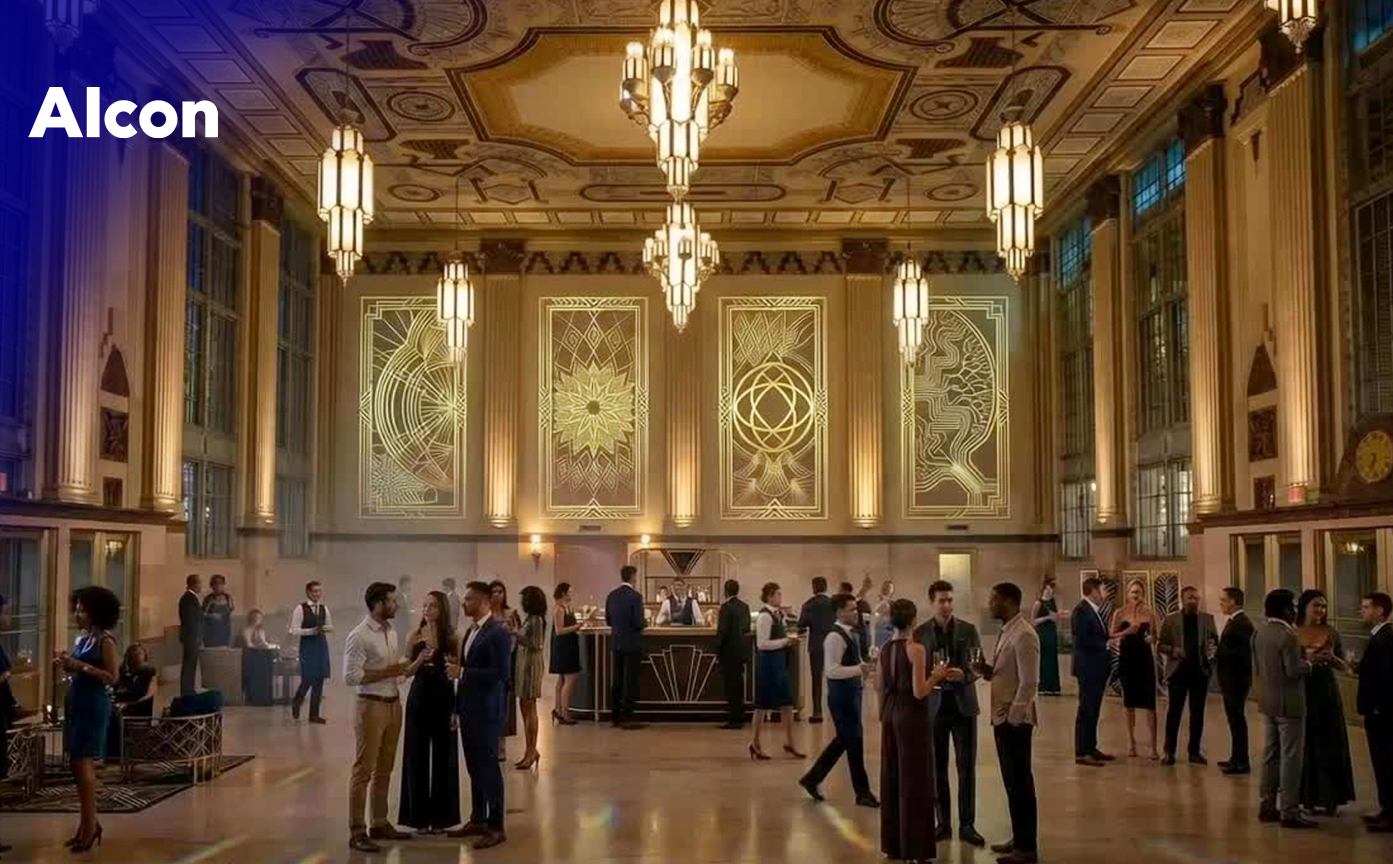
Alcon: Art Deco projection mapping at the New Technology Showcase
For Alcon’s inaugural New Technology Showcase, Groove Jones created an animated projection mapping installation inside Fort Worth’s historic T&P Station. The main terminal room features 35-foot ceilings and a primary wall divided into four large architectural panels.
Groove Jones treated the panels as a single continuous canvas. A custom visual system drew from the building’s Art Deco design language, including chevrons, sunbursts, stepped geometry, and gold linework. Subtle iris-like forms connected the animation to Alcon and its audience of ophthalmologists without turning the reception into a clinical product presentation.
The content was organized into animated vignettes and designed to loop throughout the three-hour reception, creating an ambient centerpiece for guests arriving at the event.
View the Alcon Art Deco projection mapping case study.

LEGO: “Play Is Your Superpower” in New York and Los Angeles
Groove Jones created large-scale 3D animated content for LEGO’s “Play Is Your Superpower” campaign at Vanderbilt Hall in Grand Central Terminal and the Ovation Hollywood archway in Los Angeles.
At Grand Central, mapped content extended across three walls to form a connected visual environment. In Hollywood, the architecture became a playful LEGO world filled with animated characters and action. Each approximately two-minute piece was mastered in 4K and tailored to its location using LiDAR references provided by National Experiential.
Groove Jones developed the 3D animation, visual effects, and sound design. National Experiential provided event logistics and the projection mapping AV setup. The campaign received a Platinum award at the 2025 Hermes Creative Awards, Gold at the 2026 AAF Dallas ADDY Awards, and Silver in the Out-of-Home Campaign category at the 2026 District 10 ADDY Awards.
View the LEGO projection mapping case study.
Perot Museum: Gems and Minerals Hall

For the Perot Museum of Nature and Science’s Lyda Hill Gems and Minerals Hall, Groove Jones created video and motion graphics for projection within the renovated exhibit. The mapped media complemented a hall containing 37 display cases and several highlighted signature specimens.
This installation demonstrates how projection mapping can add a digital storytelling layer to a permanent cultural space while keeping the physical collection at the center of the visitor experience.
View the Perot Museum Gems and Minerals Hall case study.
A Related Technique: Holographic Projection for Disney’s Avatar

Projection mapping and holographic projection are related techniques, but they are not identical. Projection mapping aligns imagery to a physical surface. Holographic projection can use a translucent or reflective material to make imagery appear suspended in space.
For the release of the *Avatar: The Way of Water* trailer, Groove Jones produced content for a 60-foot-wide holographic projection presented in front of Niagara Falls. National Experiential orchestrated the activation, using multiple 4K projectors and a 60-by-30-foot translucent screen to create the holographic effect. More than 600 synchronized drones added an aerial component above the projection.
The production received a Platinum award at the 2023 MUSE Creative Awards and two Best in Category honors at the 2023 Horizon Interactive Awards.
View the Disney Avatar holographic projection case study.
Getting started with a projection mapping project
A useful creative and technical brief should identify:
- The business or communication goal
- The audience and desired response
- The venue, surface, and available architectural information
- Indoor or outdoor conditions and expected ambient light
- Event dates, installation access, and operating schedule
- Desired runtime, loop structure, and sound requirements
- Whether the experience is passive, interactive, or synchronized with a live performance
- Required brand, product, campaign, and legal assets
- AV, fabrication, experiential, and venue partners already involved
- Photography, video, social, and PR deliverables needed from the activation
Early alignment on these inputs helps the creative and technical teams design an experience that fits the space, schedule, audience, and production realities.
Make the environment part of the story
The strongest projection mapping experiences do more than place animation on a large surface. They use architecture, motion, sound, technology, and audience perspective to create a moment that belongs to its location.
Whether the canvas is a historic interior, a building facade, a museum wall, or a custom installation, Groove Jones can help shape the concept, create the content, develop interactive systems, and coordinate with production partners to bring the experience to life. Contact us https://www.groovejones.com/contact


