



A few months earlier, Groove Jones had built TRI-KES a room-scale VR configurator for the HD Expo trade show floor, letting hospitality buyers apply real TRI-KES materials to a virtual hotel lobby using an HTC Vive. It worked, but it only worked at the booth. The Vive rig, the controllers, and the room-scale tracking space that made the experience compelling were also what tied it to one location and one event.

The Problem
TRI-KES’s sales relationships do not happen only at trade shows. Designers and decorators are met in their own offices, over the phone, or through a mailer that lands on their desk months after any expo has ended. TRI-KES needed a version of the same idea, seeing their materials rendered in a real interior rather than flipping through a swatch book, that could travel wherever those conversations actually happened.
The Solution
Groove Jones built a mobile Cardboard VR app for TRI-KES, launched in June 2017 for both iOS and Android. Instead of requiring a headset rig and a tracked room, the app runs on a phone dropped into a folding Cardboard-style viewer, so the only hardware a designer, decorator, or salesperson needs is the device already in their pocket.
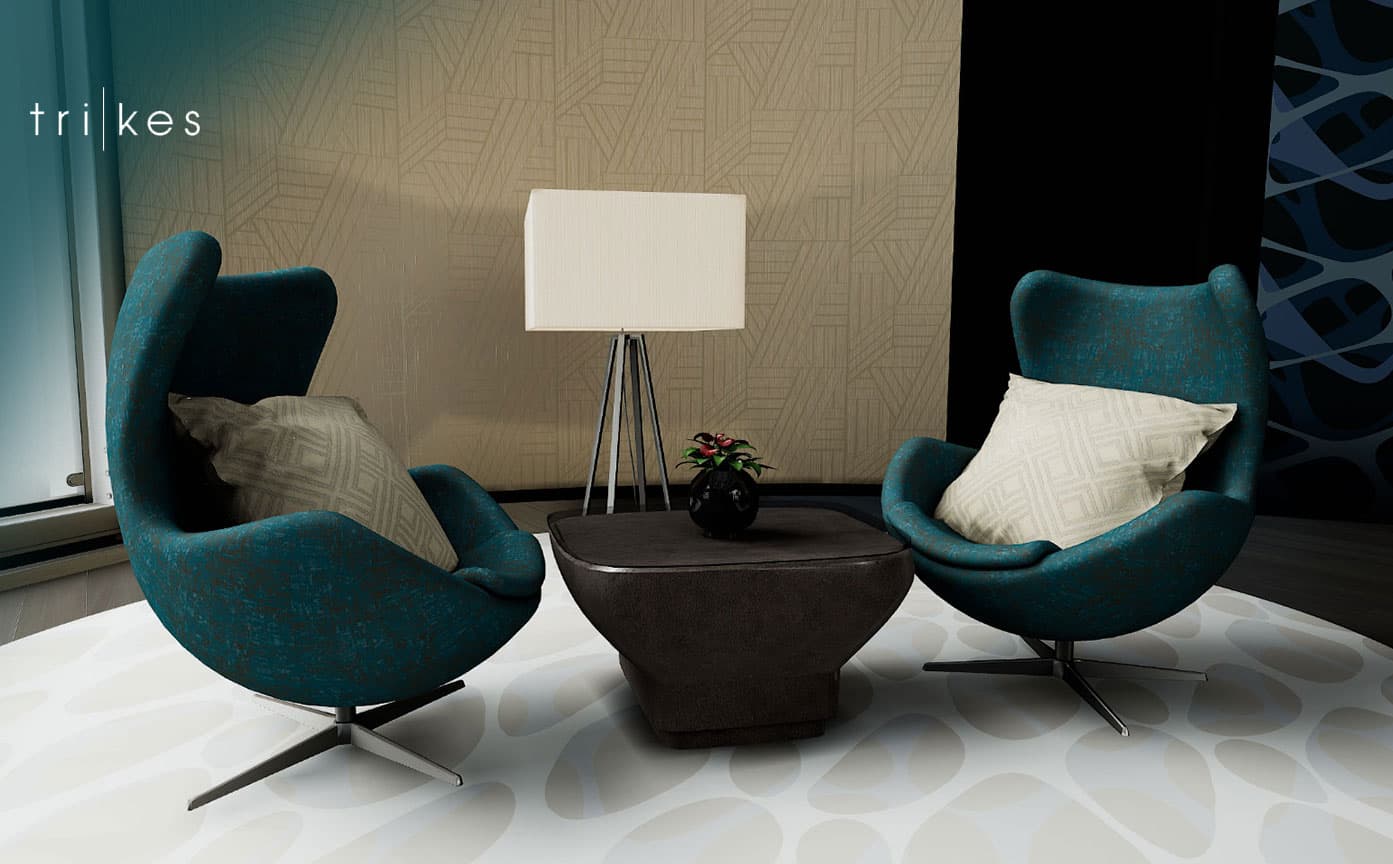
Inside the app, users are placed in an inspiring, fully realized interior space and can tour it simply by turning their head and walking through it. TRI-KES’s wallcoverings and fabric samples are applied throughout the environment, on walls, pillows, couches, and ceilings, so materials are seen in the context of a real room rather than as an isolated swatch. Gazing at any surface calls up a high-resolution close-up of that specific pattern or fabric, giving the same close inspection a buyer would get from a physical sample card, without needing to carry one.

Because the interaction runs entirely on gaze, there is no controller to learn and no calibration step. Someone can be handed a phone and a headset and be touring the space within seconds, which is precisely what made the app usable outside a staffed booth.

What the App Made Possible
- A sales tool that fits in a pocket. The TRI-KES sales team could carry a fully immersive, walkable showroom into any client meeting, rather than relying on the once-a-year trade show booth to make the same impression.
- Reach beyond any single event. Because the app lived on iOS and Android rather than tied to dedicated VR hardware, it could go anywhere a phone could go, with no scheduling or booth logistics required.
- A centerpiece for direct mail. TRI-KES built the app into a direct mail campaign aimed at designers and decorators, giving recipients a reason to do more than glance at a printed swatch card: they could open the app and walk through a full room dressed in that same material.
- Self-guided demonstration. With gaze-based navigation and no controller, the app worked as a standalone pitch a recipient could explore on their own, without a TRI-KES or Groove Jones team member walking them through it.

The Outcome
The mobile app gave TRI-KES a second life for the material library they had already built for HD Expo, this time as something that could be handed off, mailed out, and used long after any single event ended. Where the Vive-based booth experience converted attention in the moment at a trade show, the mobile version turned the same catalog into an always-available leave-behind, one that a designer could revisit on their own time and pass along to a colleague without needing any special hardware beyond a phone.